Elegy to Zuppa

According to my Italian dictionary ‘zuppa’ means: pasta, rice or vegetables cooked in broth (of meat, fish, legumes or vegetables), served with small pieces of bread, toasted or fried in oil or butter. This is only the beginning according to the ‘Elegy on Zuppa alla Frantoiana’, which we found at each of our places at the Disfida della Zuppa (Soup Tournament) at Ristorante Diavoletti in Camigliano on Friday night. Since it covers both sides of an A5 page in tiny type, I’ll try to convey its essence.

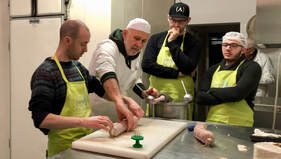
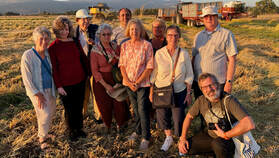
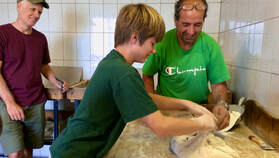
‘The Zuppa alla Frantoiana is a dish that, for the Lucchesia [area around Lucca] and in particular the plain of Lucca, represents a synthesis of territory, characteristic local produce, memories, culture and social gatherings.’ That’s a lot to pack into a bowl of soup. Yet every one of those elements was present at the Soup Tournament. A group of about 60 people — old, young, families, singles — from a radius of maybe 10 km had gathered to eat and judge a dish, made from ingredients also from a radius of about 10 km by a friend or parent or child. In judging each cook’s soup, this volunteer jury was comparing it with Zuppa alla Frantoiana as made by their mothers and grandmothers and friends and local restaurants, and inevitably recalled the many occasions on which they had eaten it. Even I, only five years in the Lucchesia, was remembering the first time I ate it at the Sagra della Zuppa (Soup Festival) at Aquilea, its annual appearance at my own village’s Ferragosto dinner and its apotheosis as created by Emma at Da Pinzo in Ponte a Moriano, not to mention my own efforts which often provide a satisfying winter supper.


The Elegy lists the essential ingredients:
  • Beans: the other vegetables are cooked in the pureed beans. The main bean is the Rosso di Lucca, but other locally grown beans can used in addition, such as the Scritto di Lucca or the Malato (‘sick’) or, occasionally, the Cannellino of San Ginese and Sant’Alessio. Since all these beans are at risk of disappearing from cultivation, it’s a good thing someone is still making soup from them. Obviously, the beans you choose affect the delicacy or robustness of the flavour of the soup.
  • Cavolo Nero Riccio di Lucca (known in dialect as ‘braschetta’), a blue-black winter cabbage with a very distinctive flavour.
  • Extra-virgin olive oil of Lucca with its soft and delicate notes (oil from olives picked toward the end of November or December, since oil from early harvested olives is bitter and peppery).
  • Stale naturally leavened bread.
  • Element of surprise: the enormous variety of other vegetables, a good part of which are wild plants from the countryside.

‘The Zuppa is a “dynamic” dish in that it has a high level of “diversity” depending not only on the hand of the cook, but also the family tradition, the village and the season in which the soup is made, determining which wild plants are available.’

Besides it’s traditional value, it has other notable qualities:
  • characteristic aroma and flavour;
  • requires time and patience to obtain a memorable result;
  • important dish in ‘cucina povera’ (peasant cooking) for utilising leftovers and whatever is available in the kitchen, vegetable plot and hedgerows;
  • perfectly balanced nutritionally: carbohydrate from the bread, protein from the beans, fiber and minerals from the vegetables, noble vegetable oil from the extra-virgin olive oil.

The Elegy ends with a plea. Increasingly we find banal versions of this traditional dish on the menus of bars that serve food reheated in the microwave and on the shelves of supermarkets packaged in simulated plastic terracotta for the microwave. We mustn’t forget the proverb: ‘There is no future without memory’. Let’s keep the original identity of the Zuppa at the heart of present-day and future creativity. 
This entry was posted in SOUP. Bookmark the permalink.

Leave a Reply

Your email address will not be published. Required fields are marked *

*

You may use these HTML tags and attributes: <a href="" title=""> <abbr title=""> <acronym title=""> <b> <blockquote cite=""> <cite> <code> <del datetime=""> <em> <i> <q cite=""> <strike> <strong>

1322160626 social_rss_box_orange1322160582 facebook1322160607 Twitter_32x32