
|
If you’ve been to the mountains of Italy, I bet you’ve asked this question yourself. You’re probably in a car on a road hugging a river and you’re craning your neck to look up at a terracotta-roofed village improbably balanced on an inaccessible ridge. To find the answer you have to abandon your car, get into your time-machine, key in ‘Middle Ages’ and click GO. 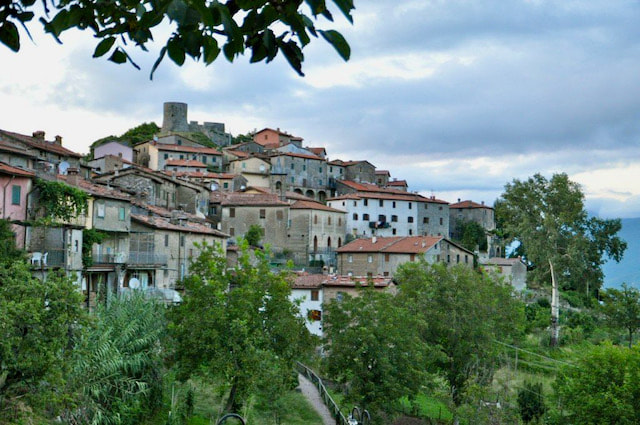 A hilltop village With no discomfort on the way, you find yourself on a broad cobbled road nearly at the crest of the ridge looking down at that very spot in the valley you just vacated. You see the river running swiftly in the shadow of sheer rock walls that not even a mountain goat could scamper across. Your car is nowhere to be seen, because the road won’t be cut through the rock for several centuries. Your eyes follow the river to the left where it emerges from the gorge, still in the shade at noon, and disappears into a thicket of dense scrub on a river plain that floods in winter. You walk next to your mule laden with your jeans, T-shirts and iPad and in five minutes emerge into full sunshine at the ospedale next to the church in the village, where you are welcomed by a monk and offered a meal. As you tuck into your succulent boiled salt pork ribs, a large bowl of tasty chestnut-flour polenta and a skin of wine, you’re cooled by a soft mountain breeze that ripples through the golden farro in small terraced fields. A couple of enormous black pigs with pink belts around their middles wallow in a puddle formed by the spring that issues from higher up the mountain and provides clean cold drinking and washing water for the village. It must have been hard work creating the terraces, but the place is swarming with strapping young sons who look as if they’ve been down the gym pumping iron all morning, and it’s obvious time isn’t in short supply either. After lunch you’re not allowed to depart before having a snooze on a bed of hay in the inn, air-conditioned by the thick stone walls. 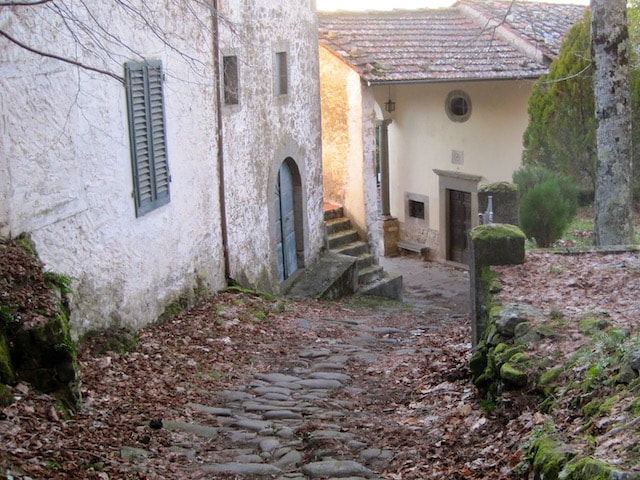 Arriving at the mediaeval village Although you’ve signed up for a slow travel tour, you still have to get to the next village by evening. A shepherd setting out with his flock offers to accompany you and show you the way, not that you need help to follow the broad, well-maintained mule track bordered by dry-stone walls. He’s been visiting his sister who married one of the men in this village, and his aunt and uncle live here too. There are many family connections between adjacent villages on this slope and those just over the top behind the village. It’s all so convenient living right on the main mule track; nothing is much more than an hour’s walk away. As you amble along, he tells you that the village you’re heading for lies just below a fort, part of the Republic of Lucca’s line of defense against the warmongering Florentine Republic. The ridge serves as an ideal lookout point, but the garrisoned troops are always drunk, and he’s sure those sheep that went missing provided Sunday lunch for the officers. Besides, he lowers his voice conspiratorially, he and a couple of other shepherds, who know the tops of the mountains like the eagles, had a good trade in contraband chestnut flour and firewood with the Florentine citizens just over the border. All at an end now, of course. After about 50 minutes, at a fork in the road, the shepherd bids you farewell as he continues up to his house in the summer pasture half an hour away and you saunter down the slope to the village bar just in time for a gin and tonic and a pizza margherita. Oops! You must have accidentally hit the ESC key on the time machine. You can tell because they didn’t have tomatoes in mediaeval times, and there are those telltale electric fairy-lights in the bar garden. Oh well, now that you’re back, let’s do the return trip as a 21st-century hiker. 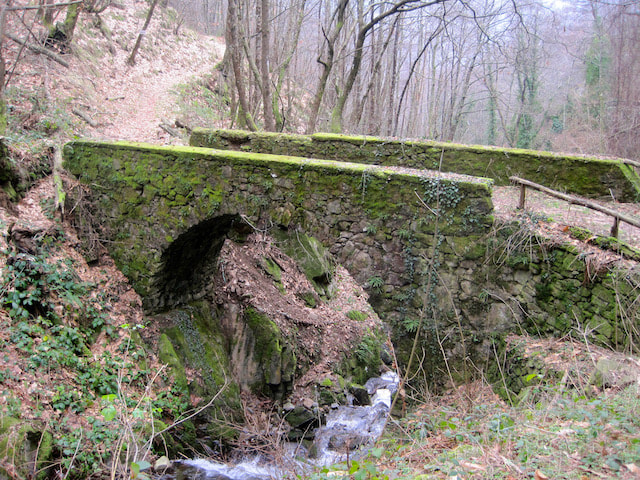 The mule track, being inaccessible even by a Fiat Panda 4×4, has become overgrown, many of the cobbles have washed out and in places no trace is left. No matter. You shoulder your rucksack and set off down the tarmac road to the valley bottom, which takes 45 minutes. Turn left and walk along the state highway cut into the sides of the valley or raised above the boggy valley bottom. The sun finally got here at about 12.30 pm, the tarmac is still blazing hot and there’s no cooling mountain breeze down here. An hour later you arrive at a village in the valley bottom, built mostly since the 1950s to be near the factories that exploit the river water. Turn left and for another hour and a quarter climb steadily following the interminable switchbacks of the car road, built in the late ‘50s, to arrive after a grand total of 3 hours back where you had lunch. QED. Where did that mule go? 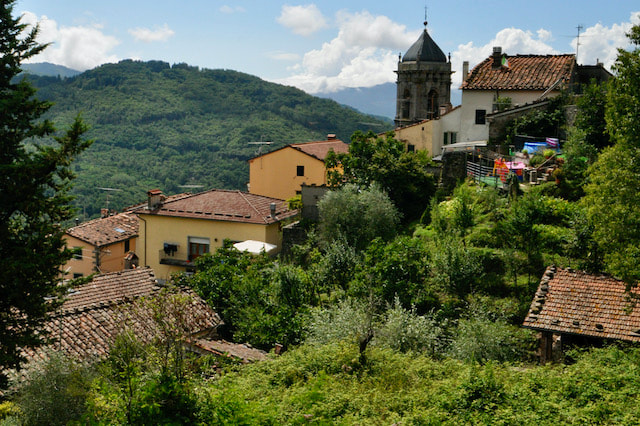 Another idyllic hilltop village If you landed here by chance and would like to be notified of future posts, you can sign up here.
If you’d like periodic news about our tours and courses, sign up here. This blog was originally published on Slow Travel Tours on 7 March, 2011.
0 Comments
Did history lessons make you feel that a cloud in the sky outside the classroom window was absolutely riveting? They did me. If only I could have gone to the village shop for my lessons. The shop is only 30 seconds walk from my front door. You can get almost anything there from meat to dry goods to paintbrushes, and I go every morning to buy at least some bread that comes from a village 5 km away up the valley. 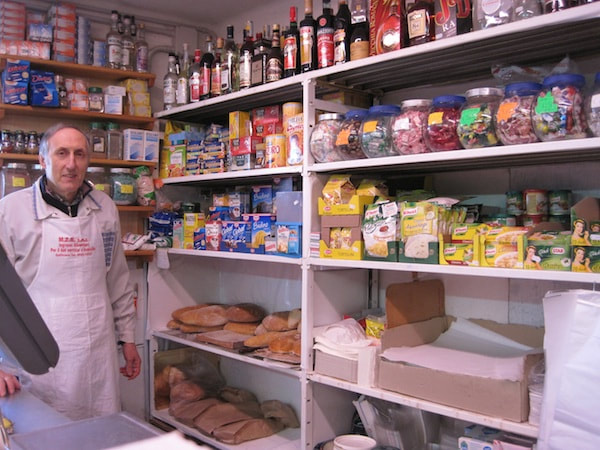 Renato and everything you could want at the village shop 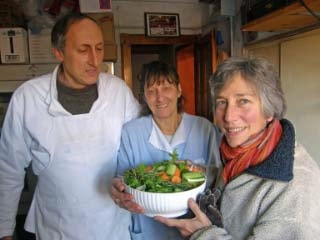 Eugenia sometimes prepares ready meals you can buy in the shop One morning about a month ago I commiserated with Eugenia about her ankle which she sprained while getting water at the spring up at the cemetery to wash the grave stones of her ancestors buried there. She commented that we’d had too much rain and the stones were slippery with moss. 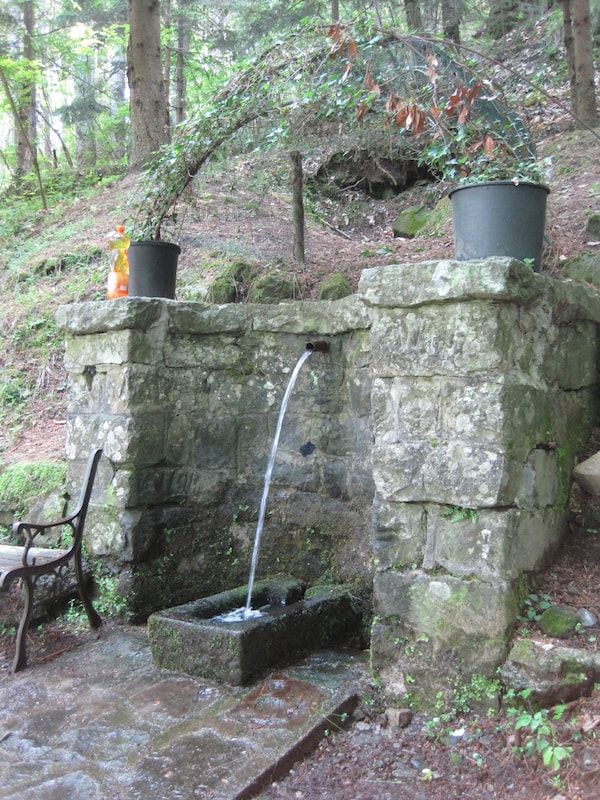 The guilty spring and its treacherous paving stones 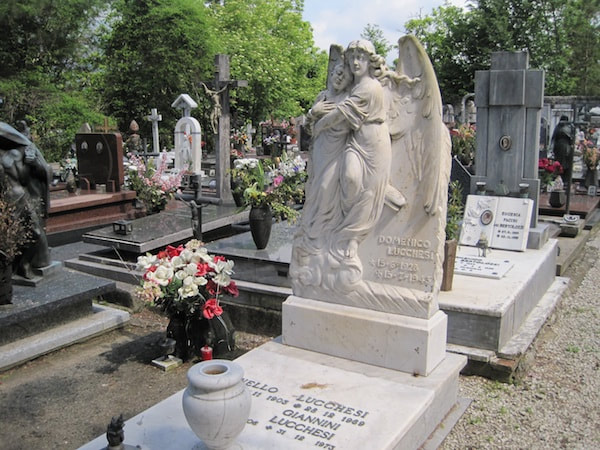 Centuries of history in the Casabasciana cemetery Yes, I agreed, but it was beautiful yesterday and I went for a walk down to the river, across the foot bridge and up the valley along the road to the little dam that is part of a micro-hydroelectric plant. 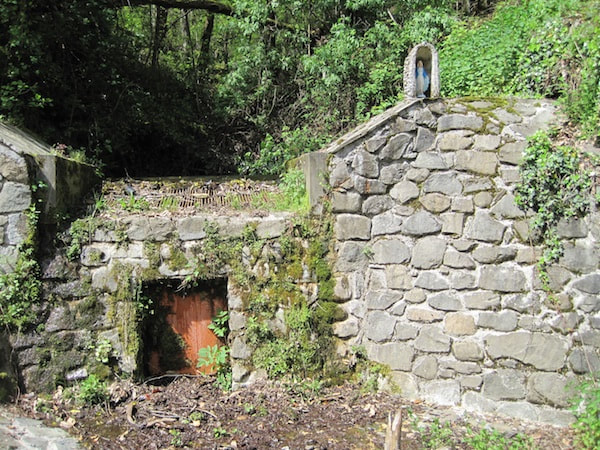 A tiny madonna guards the micro-hydro dam. 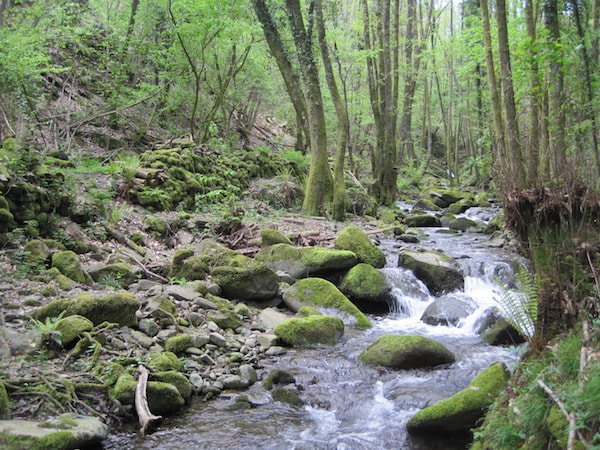 A river both beautiful to behold and useful for electricity Renato explained that it furnishes the water for the main plant at the foot bridge, which used to be a silk spinning factory. I knew that silk was one of the main sources of wealth for the Republic of Lucca in mediaeval and Renaissance times and the silk industry had only completely died out in the 1970s, but I hadn’t realised that even at Casabasciana people reared silkworms. I take my guests to visit Stefania Maffei who rears silkworms like her grandmother did and runs workshops for school children to reacquaint them with their own history. 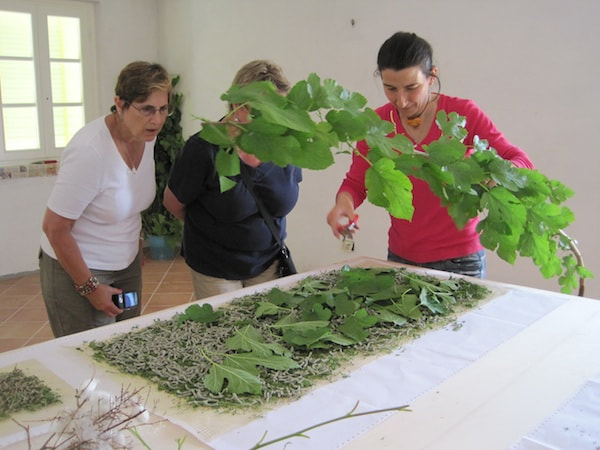 Ravenous silkworms at lunch 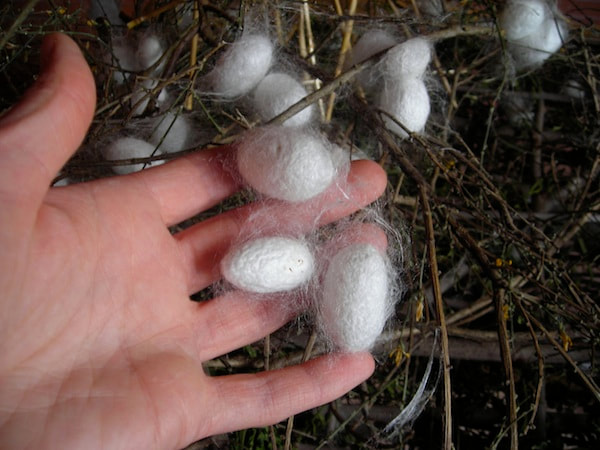 It’s worth the effort serving mulberry leaves to silkworms several times a day I asked where the mulberry trees were, since I hadn’t seen any. They’re mostly gone now, but Renato knew of one in a field near the little church below Crasciana (the village 3 km above Casabasciana). I mentally add that to my list of things to find. Talking about old industries, I remembered to tell them that I had just noticed the old kiln Eugenia had told me about last year, where they used to make terracotta bricks and roof and floor tiles. It’s only 5 minutes’ walk down the old cobbled mulattiera (mule track), just below where the modern road cuts through the track and above the madonnina (a wayside shrine). I’d never noticed it before, but this time I was looking from side to side for wildflowers and there were the ruins covered by brambles. 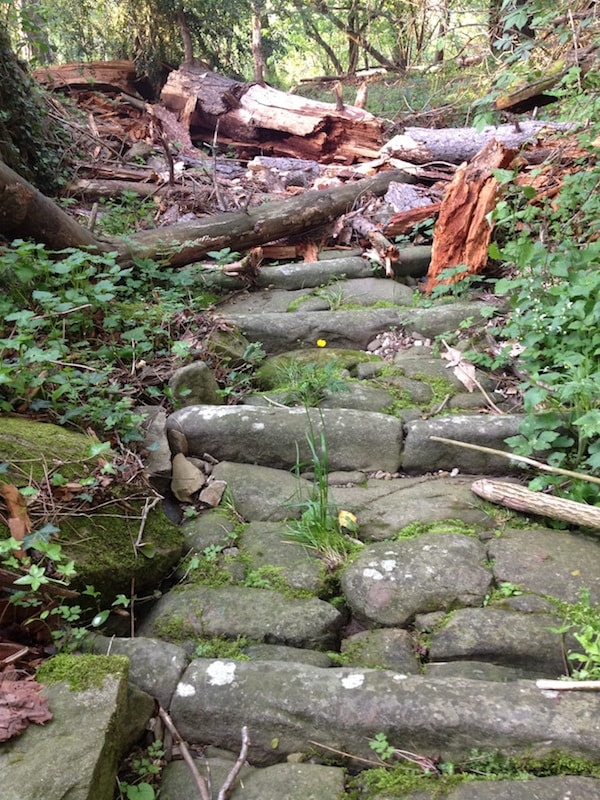 Beautifully constructed cobbled mule track getting covered by falling trees 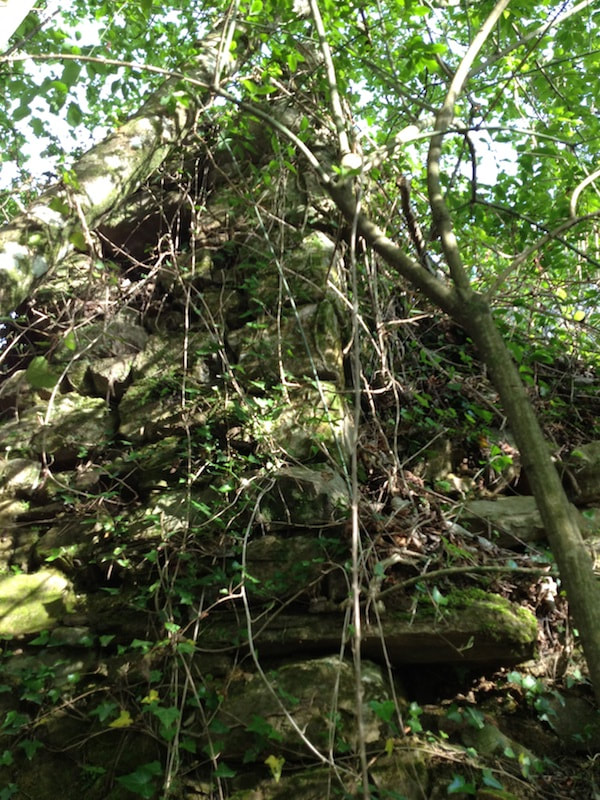 The kiln becoming an archaeological remain — no wonder I’d missed it 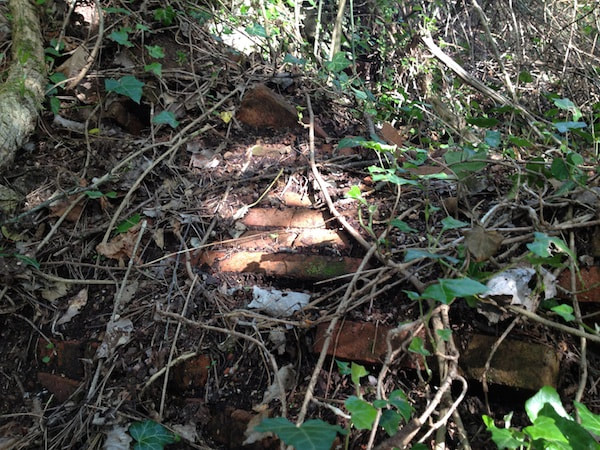 Never-to-be-sold terracotta bricks produced at the kiln 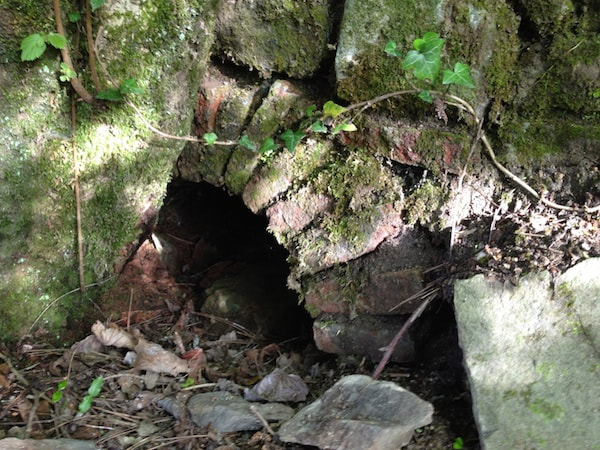 Air vent beneath kiln Piqued by my apparent interest in building materials, Renato volunteered that there used to be a lime kiln at Crasciana which produced the lime for mortar and lime-wash used for centuries in buildings here. Actually, although I’m interested in architecture and the aesthetics of buildings, the mechanics of building have never gripped me. But now, the fact that these things used to be made right here around me, caught my imagination and when I got home, I looked up lime extraction and processing on the internet. 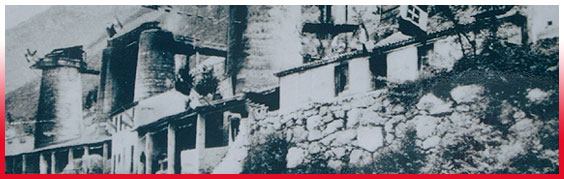 I wonder if the Crasciana lime kiln looked like this I’m going to find out where our kiln was and and try to locate the ruins. Two days later I learned from my landlord that one of the cellar rooms of the house was the calcinaia, where they used to slake the lime when whitewashing the walls of what was formerly one of the grandest houses in the village. 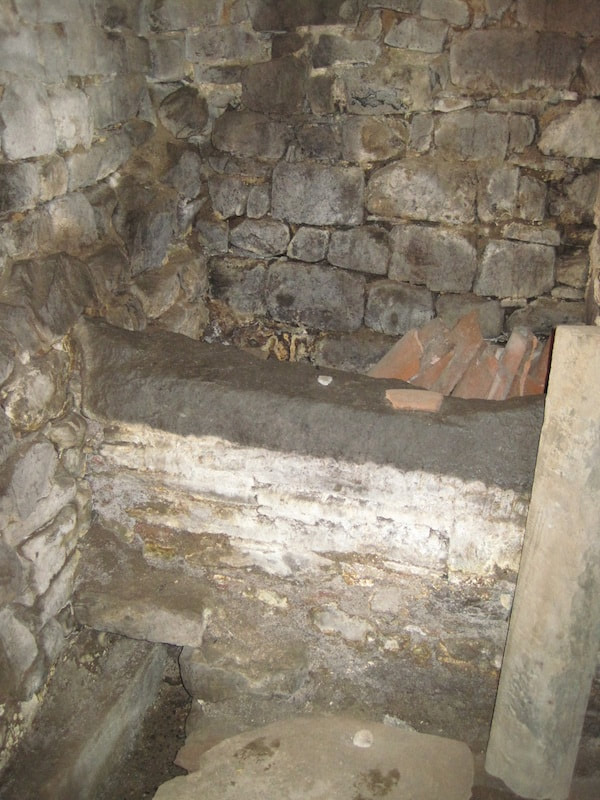 Basin for slaking lime to make whitewash for the walls of my house Everything begins to come together. Maybe that was what was wrong with history before. It was the equivalent of ‘fast travel’ — too many isolated facts without any connection to anything.
If you landed here by chance and would like to be notified of future posts, you can sign up here. If you’d like periodic news about our tours and courses, sign up here. This blog was originally published on Slow Travel Tours on 3 June 2012. As a tour designer and guide I don’t get many opportunities to experience what it’s like for you to travel to a place you’ve never been to before. The only chance I have is when I research a new tour or course. And I did just that in March 2018. I want to offer a mozzarella course (update: I now do). Since we don’t make mozzarella in Tuscany (not properly, anyway), I had to go to Campania in the south, the home of water buffalo and birthplace of mozzarella. You probably know Naples, Pompei and the Amalfi Coast, but I hadn’t even been to any of these. 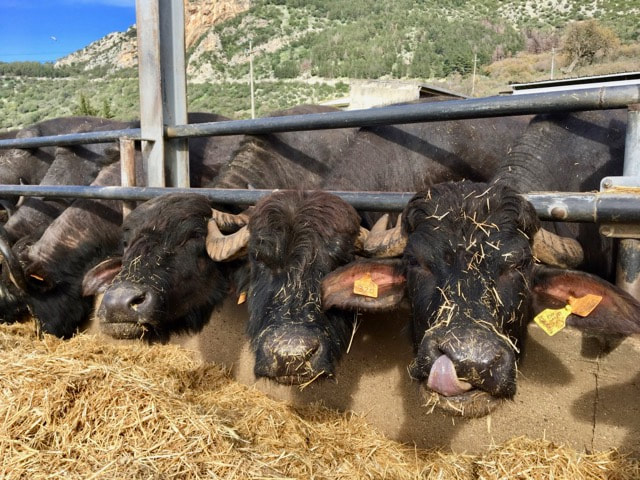 Greedy girls It was a bit daunting going south of Rome to the infamous Mezzogiorno of lawlessness. But I had a big advantage over the average tourist: I had locals to show me around. I had met a Scottish woman on a Ryanair flight from London Stansted to Pisa. Her Italian husband was from the province of Salerno, just south of Naples. I knew that Salerno and Caserta provinces were famous for their mozzarella. When I told her of my plan, she said they live in Florence now, but her husband knew the Cilento area inside out (central and southern part of Salerno Province). A couple of months later I found myself at Santa Maria Novella station in Florence, boarding a train bound for Salerno with Audrey and Enrico. I was to stay at their house in Trentinara. They were renting a car and they were going to introduce me to owners of agriturismi (farm accommodation), a mozzarella dairy and restaurants. Everything I would need for the course. 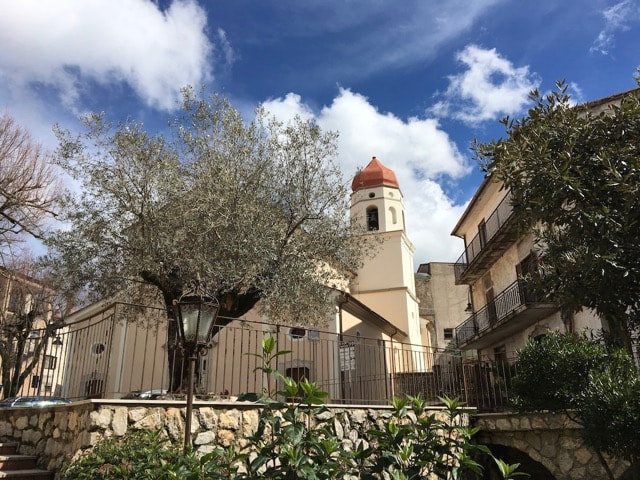 Piazza with olive tree and church, Trentinara First a stop at an agriturismo Aia Resort Cilento owned by Vincenzo, an architect friend of Enrico’s. It’s perfect for the course: tasteful rooms with private baths, a swimming pool, pizza oven and BBQ. 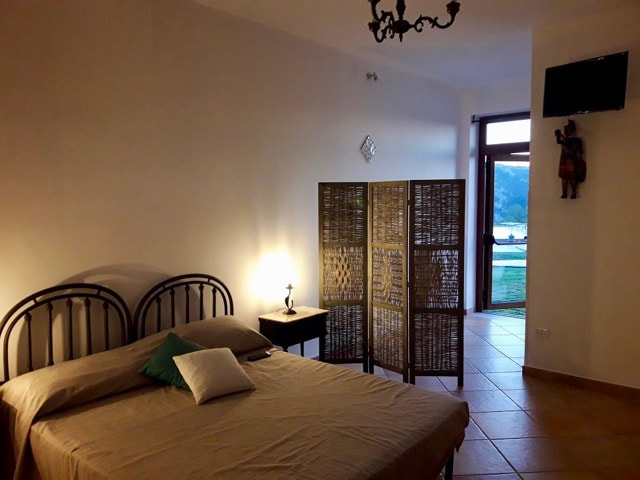 Room with a view of the pool, Aia Resort Cilento It was after dark when we arrived at their house and, while Enrico lit the fire, Audrey took me next door to meet her mother-in-law Antonietta. Even though we planned for dinner to try the restaurant owned by Enrico’s cousin, it was compulsory to sit down at the table to sample Antonietta’s stuffed artichokes (carcioffule ‘mbuttunate), lately picked from her garden. I had to forcibly prevent her putting two on my plate. 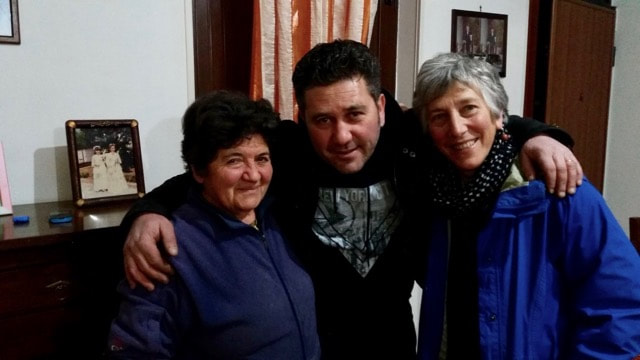 Antonietta, Enrico and me (photo: Audrey Pate) The next morning we met my cheese and salumi courses colleague Giancarlo Russo, who had arrived separately, and proceeded a short distance down the road to a private house to meet Lilla and her son Antonio La Mura. Lilla is a great cook (as it seems is everyone from this area) and might give a short cooking lesson either during the mozzarella course or during an optional extension before the course. We gathered around the table in the kitchen to talk. But no talk without food in these parts. Antonio went to the cellar and came back with his own salsiccia (air-dried sausage). Lilla sliced her homemade bread, made with sour-dough starter and baked in a wood-fired oven, while Antonio uncorked a bottle of excellent homemade wine. 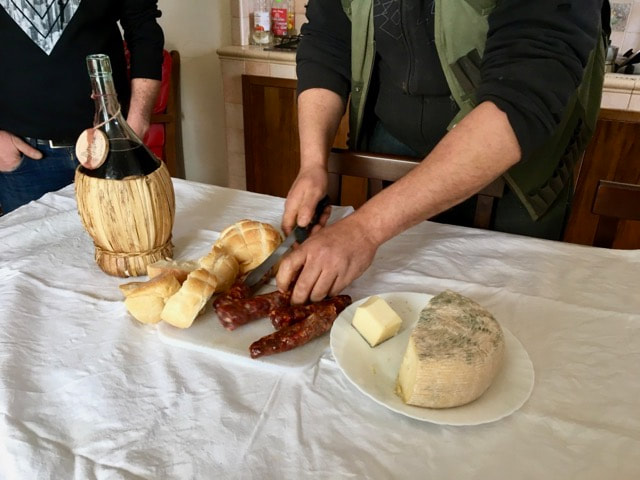 A frugal tasting, we assumed. Giancarlo and I have tasted a lot of sausage and salami in our day, and this was exceptional. Encouraged, Antonio disappeared down below again and re-emerged with two cheeses and a salami, all of his own production. 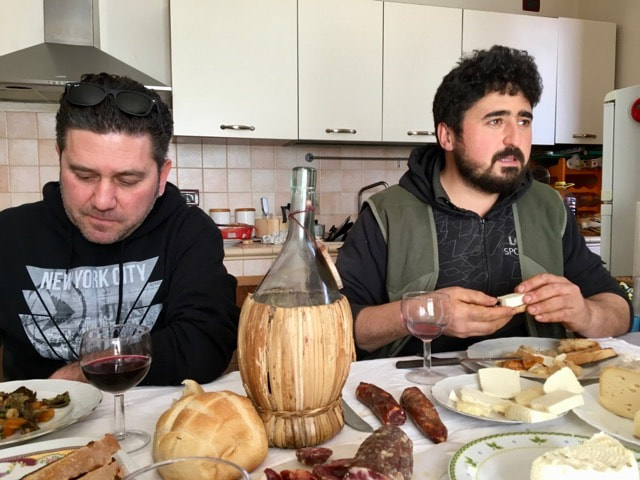 The table was filling up. Enrico (left) and Antonio (right) enjoy their native food. Last (at least we were hoping it was), a cured sausage called nnoglia, which was stuffed with lungs and other of the least noble parts of the pig. Usually it’s used to flavour vegetable soups, but Lilla threw it on a grate over the fire that warmed the room. More delicious than you can imagine. 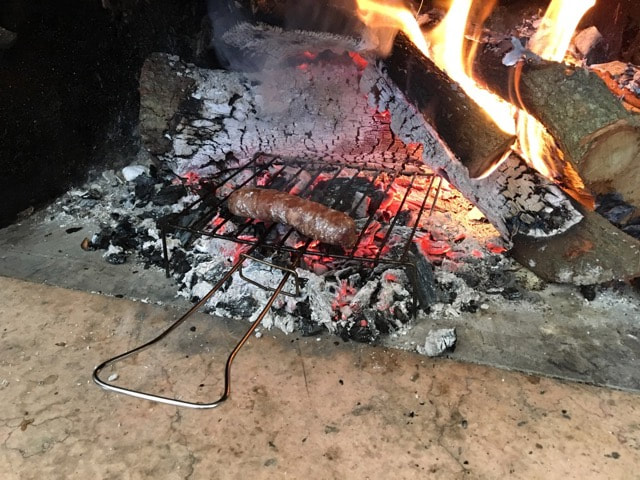 The nnoglia on the grill was already smelling tempting. She just happened to have some pastries from the local shop, and we weren’t allowed to leave without coffee and a digestivo, her homemade finocchietto, alcohol infused with fennel leaves and flowers. Good thing we hadn’t booked lunch at a restaurant! 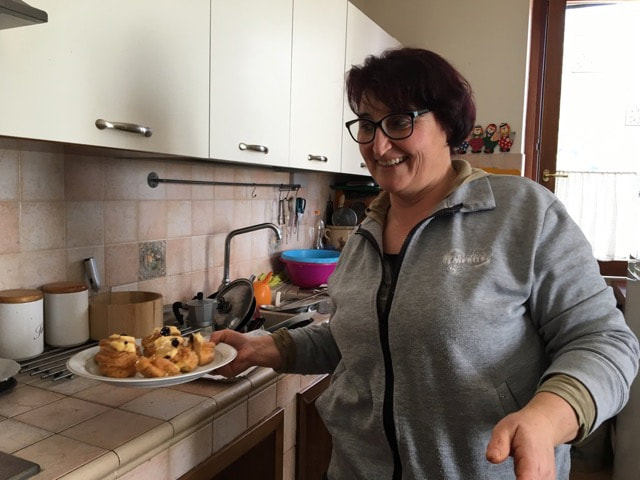 We felt enveloped by Lilla’s hospitality and cheerful disposition. After that feast of salumi, we had to see Antonio’s pigs… 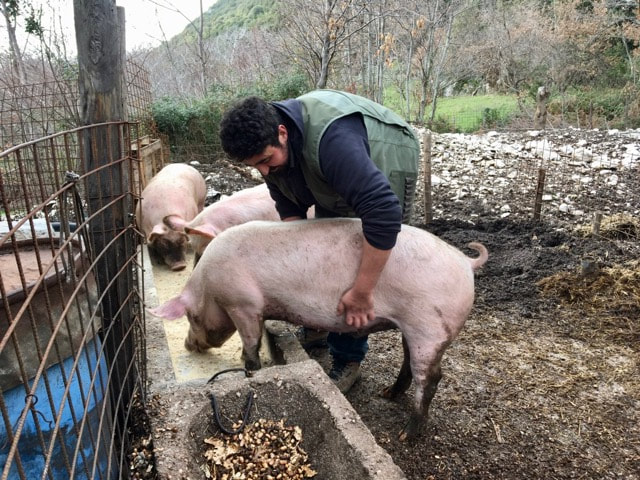 The pigs get some grub and a good scratch. and his cows… 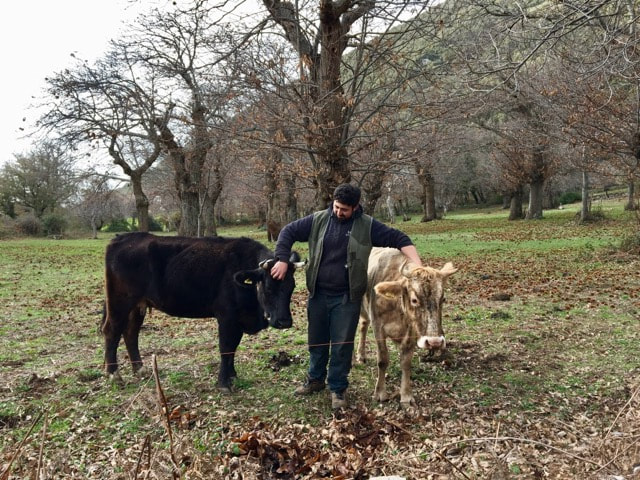 Antonio is very fond of his animals. in the oak and chestnut woods where they have parties in the summer. 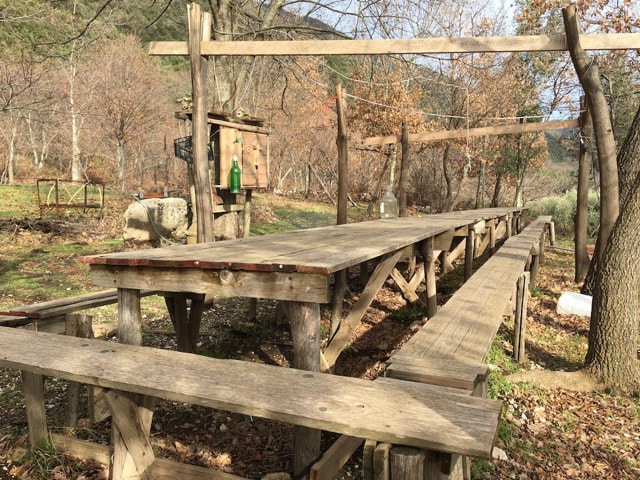 I hope we’re on Antonio’s guest list. That evening at 10.30 Giancarlo and I had an appointment at Caseificio Prime Querce to watch the whole process of making mozzarella and its pasta filata (spun curd) relatives scamorza, burrata and caciocavallo. The head cheesemaker Antonio (everyone seems to be named Antonio) is, of course, a close friend of Enrico. He showed us every step, explaining the reason for each process and giving us generous samples to taste. 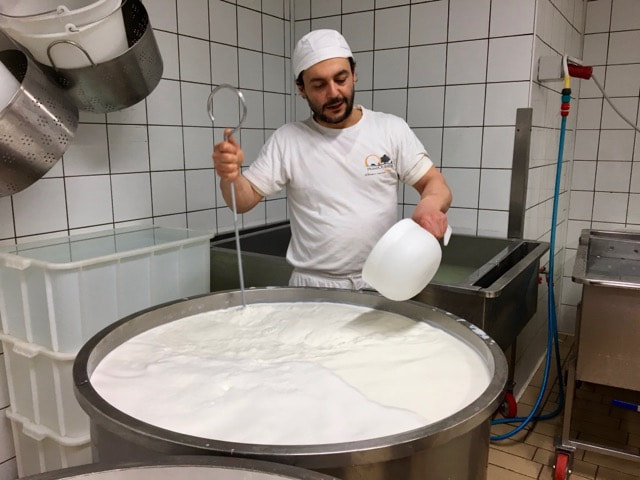 At the beginning of the process Antonio ‘il Lupo’ adds rennet to the warm buffalo milk. Even though hIs nickname means ‘the wolf’, he was very gentle with us. 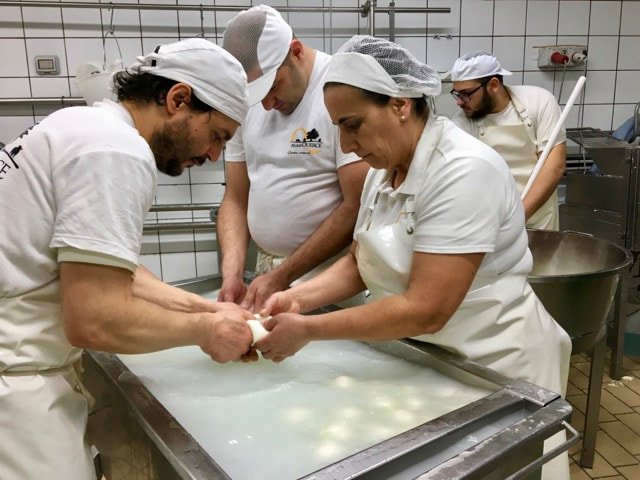 At the end of the process each mozzarella is pulled off the mass of spun curd (mozzare means to separate or amputate). Some is made by hand like this and some by machine. But the mozzarella wouldn’t be at its peak until it had bathed in brine for another five hours. We finally left around 2.45 am. The next morning Antonio stopped by Enrico’s house to drop off two bags of mozzarella, one hand-formed and the other moulded by machine. It was a revelation! Juicy, firm and milky. How can I go back to eating week-old mozzarella in Tuscany? 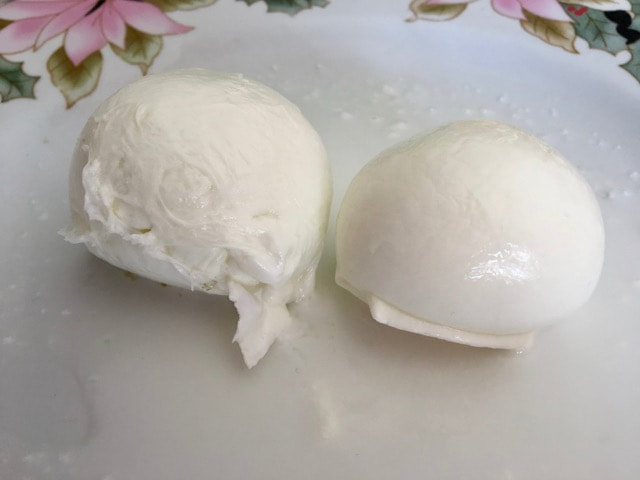 Would you believe you can taste the difference between handmade (left) and machine-moulded (right)? We still hadn’t had a tour of the town with Enrico and Audrey, so we set off up the streets of Trentinara, hailed and stopped at every corner by Enrico’s cousins and friends. At the top we made the day for Zì Cosimo, the basket weaver. I learned that here ‘zì/zà’, literally meaning ‘uncle/aunt’, is a title of respect for older people. 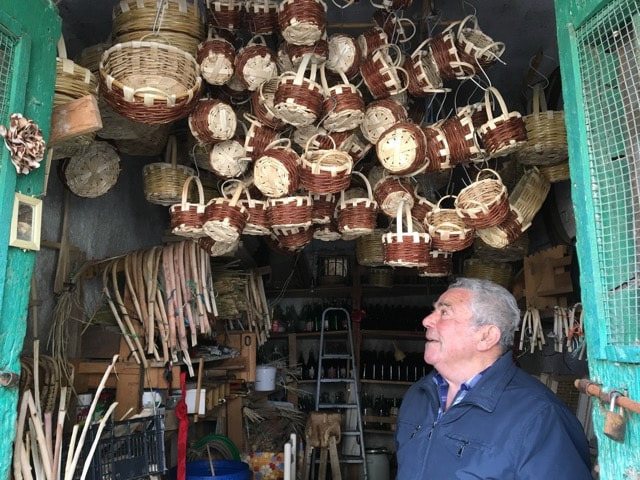 Zì Cosimo glowing from our attention 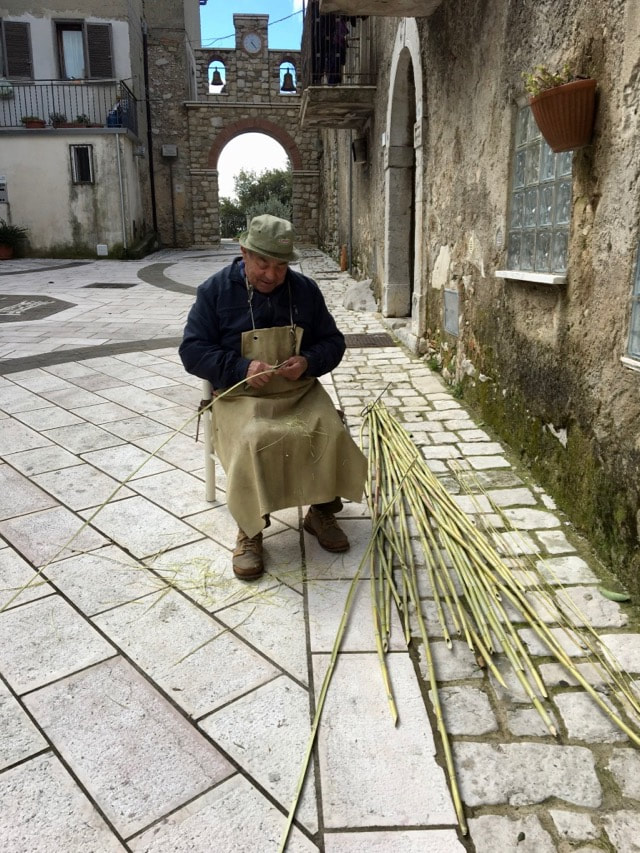 Preparing canes for his baskets seated on the paving stones Enrico laid for the town. 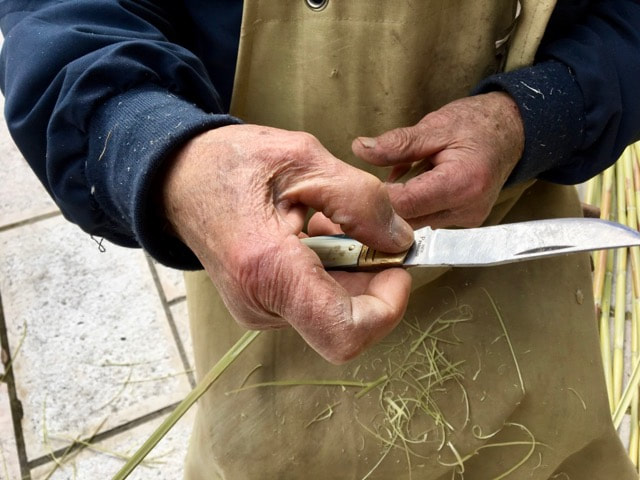 The hands and knife of a skilled artisan 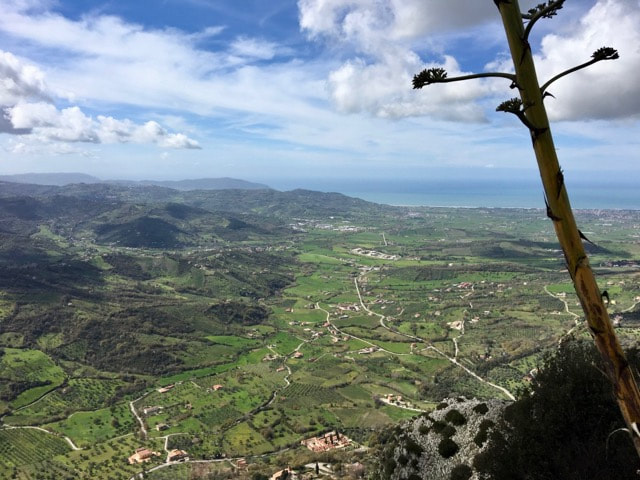 View toward the sea from the arch behind Zì Cosimo. The ruins of the ancient Greek city of Paestum are on the plain around to the right. On the way to the restaurant for lunch we passed Enrico’s aunt carrying a basket of freshly baked bread from her wood-fired oven. 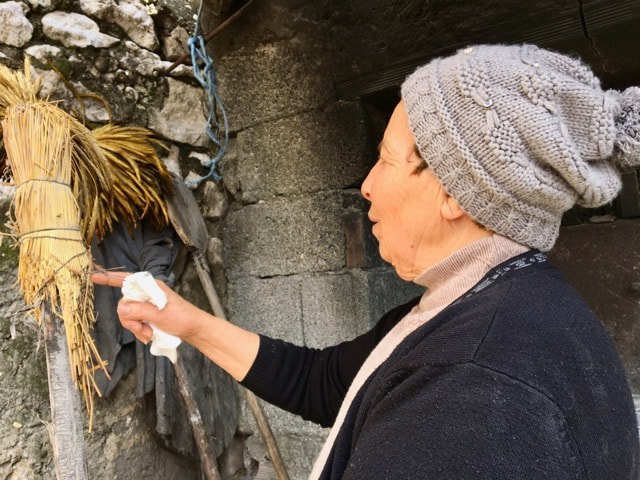 Zà Erene shows us the broom made of barley ears which she uses to sweep her oven. We were wondering how we could stuff in lunch after gorging on mozzarella for breakfast, but we needn’t have worried. Locanda Lu Vottaro, owned by the chef Cristina—you guessed it, a friend of Enrico, was closed, but she opened specially for us and prepared a superb tasting menu. 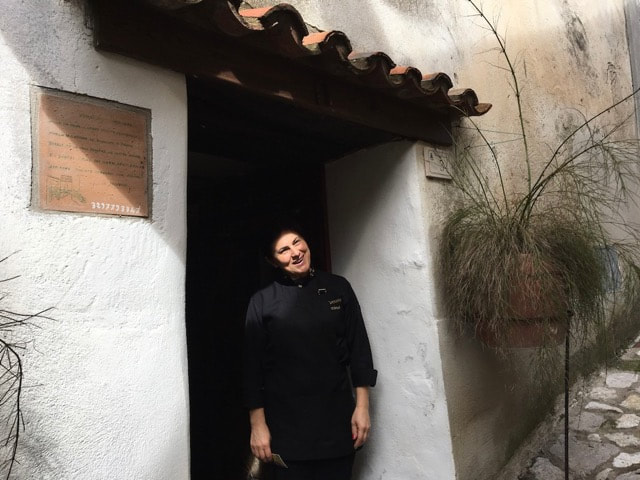 Chef Cristina in the doorway of her inn… 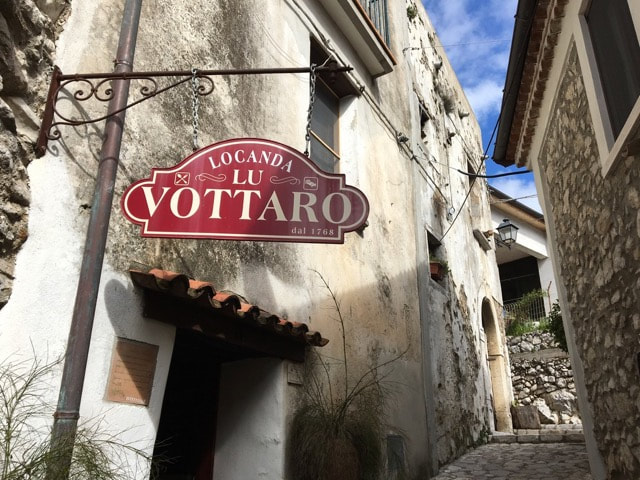 …a Slow Food osteria 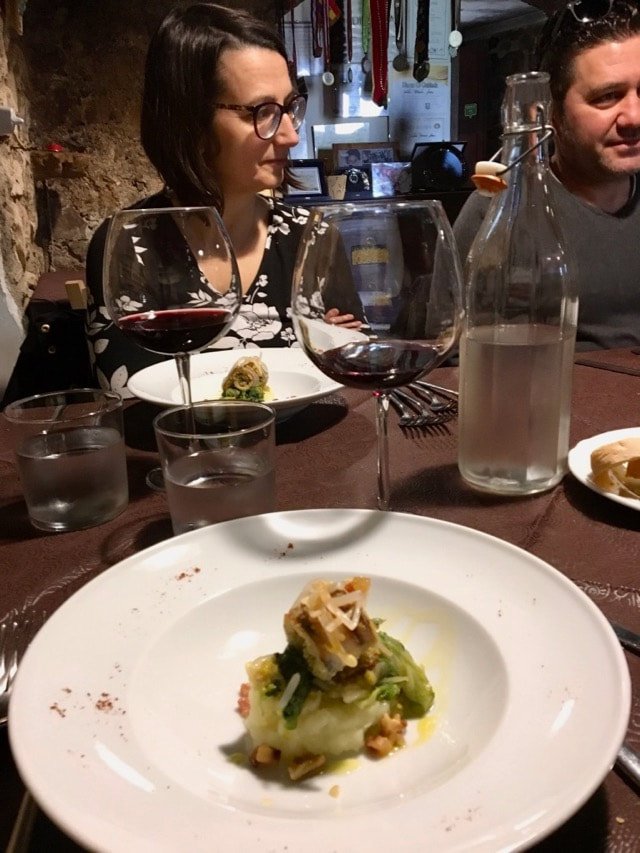 Simple local, seasonal ingredients creatively combined to make light modern dishes It was time to leave our friends Audrey and Enrico, this town and the people who we felt we already knew well. Suddenly I realised this must be what it’s like to go on a tour with Sapori e Saperi Adventures. You’re met at the station, transported to your accommodation, escorted to see places and meet people you could never find on your own. They open their arms to you because you’re accompanied by us, their friends. What better way to spend a holiday?
Take a look at the result of this course for professional cheesemakers and keen amateurs: Mozzarella & its Cousins. If you're not a cheesemaker, don't worry, there are less specialised small group tours and courses like Olive Oil: Tree to Table for you. If you landed here by chance and would like to be notified of future posts, you can sign up here. If you’d like periodic news about our tours and courses, sign up here. This blog was originally published on Slow Travel Tours on 28 March 2018. The guests on our inaugural Giants of Sardinia tour excelled themselves with a little help from our stellar food producers. They scampered to the top of the megalithic nuraghe Barumini. 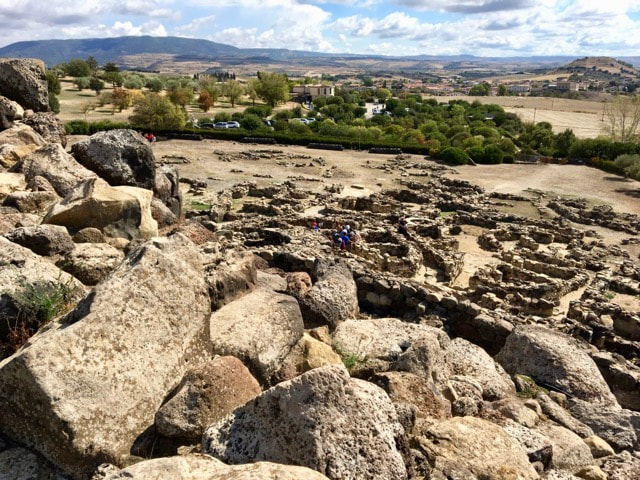 View from the tower They picked and brined olives with Davide Orro and his mother Angelica. 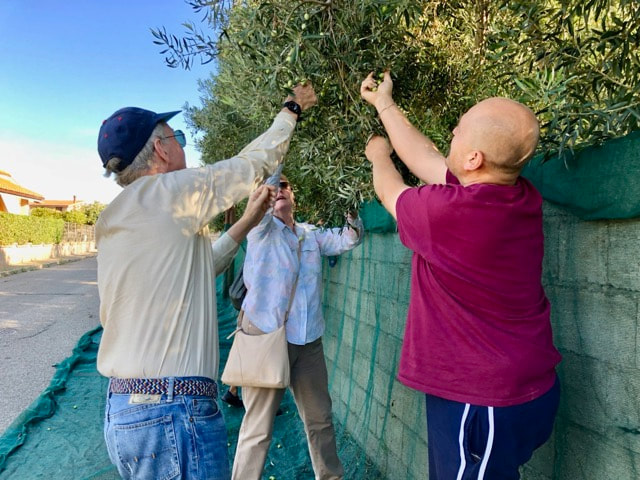 Picking olives was child’s play. 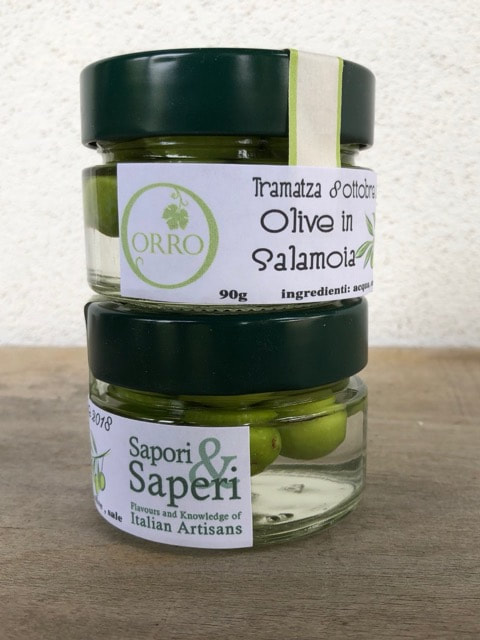 The labels designed by Davide’s sister Maura made our jars look professional. They manipulated with dexterity the dough for Oristano wedding bread with Davide’s sister Ester. 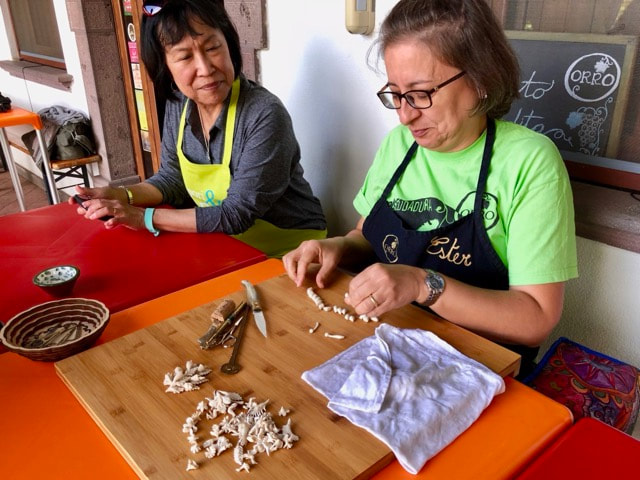 Ester made it look easy. 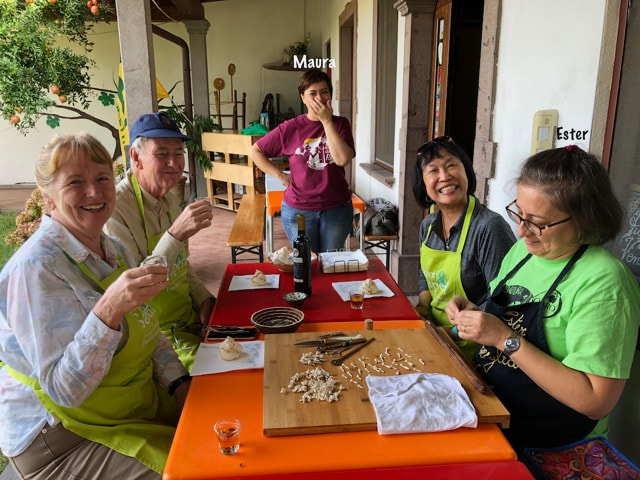 And it was after a few sips of vernaccia di Oristano. It was no problem at all tasting the rest of Davide’s superb wines with seductive labels designed by his other sister Maura. 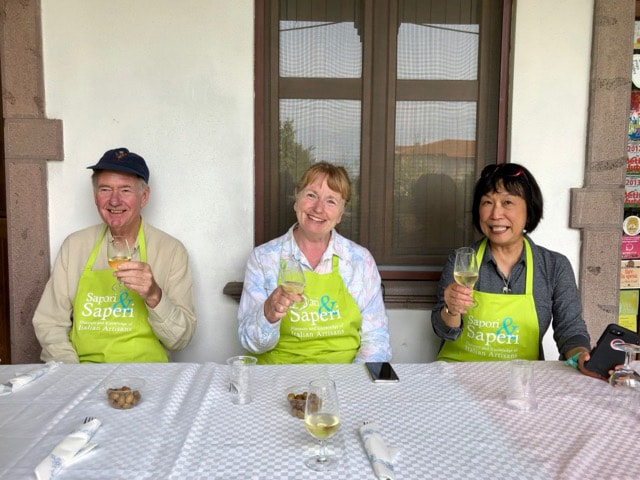 Correct preparation for a tasting lunch They learned the proper way to make Italian risotto with Marcello Stara’s rice under the tutelage of his friend Rossella. 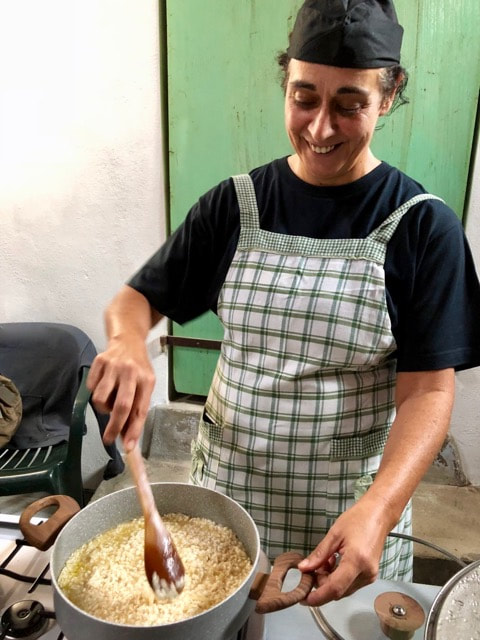 Risotto should be creamy and the grains of rice firm but not crunchy. With butcher Paolo Lilliu they overcame the difficulties of stuffing Sardinian sausages… 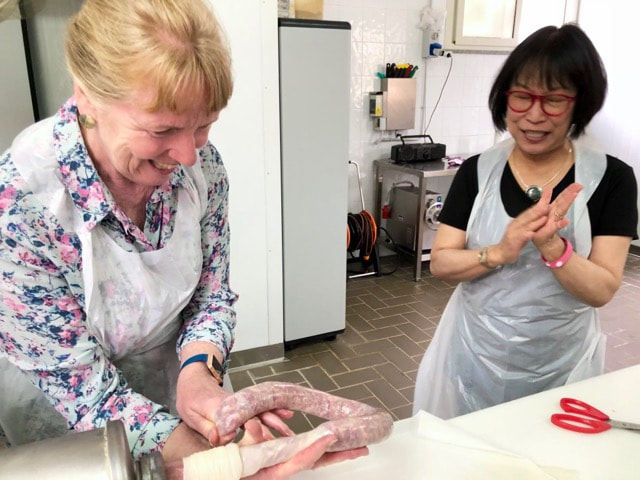 Brava! …and ate them barbecued for lunch. 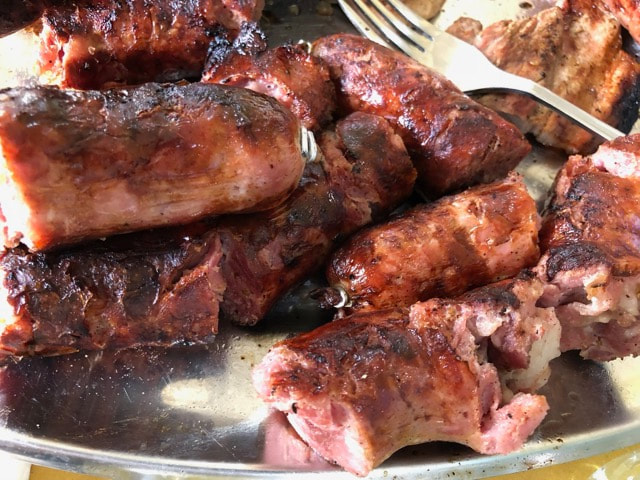 Delicious! Even if their Casizolu, a Slow Food caciocavallo-type cheese, wasn’t quite perfect, it was lots of fun modelling the curd. 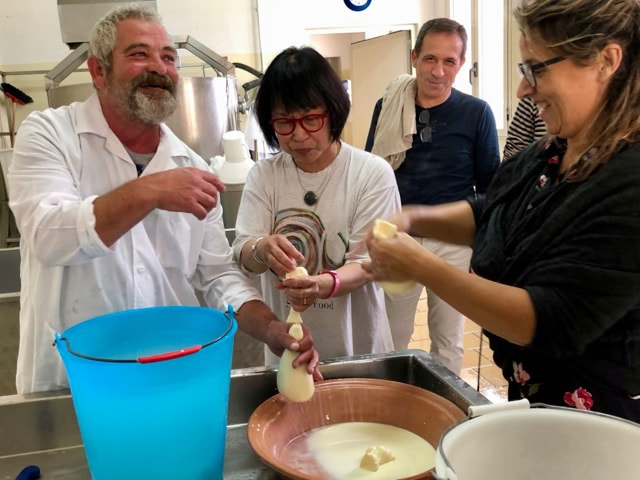 If you weren’t careful, you could end up with a cheese with a giraffe-length neck. It seemed that making stuffed pasta culurgiones was going to defeat them, but practice makes perfect and success was theirs in the end. 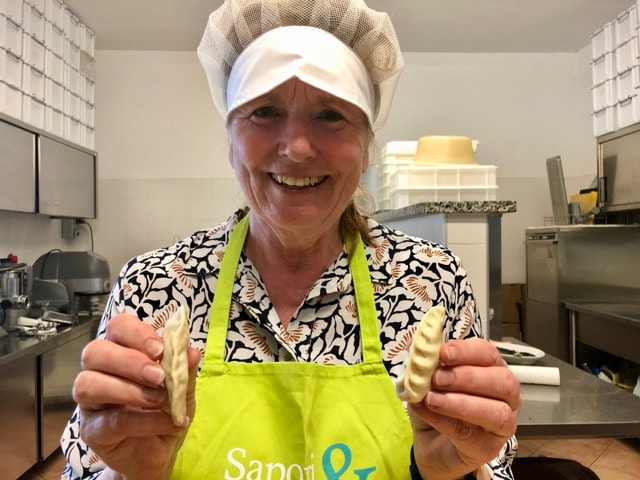 Before (left) and after (right) I’m glad we didn’t have to do battle with the Bronze Age nuragic giants at Cabras. 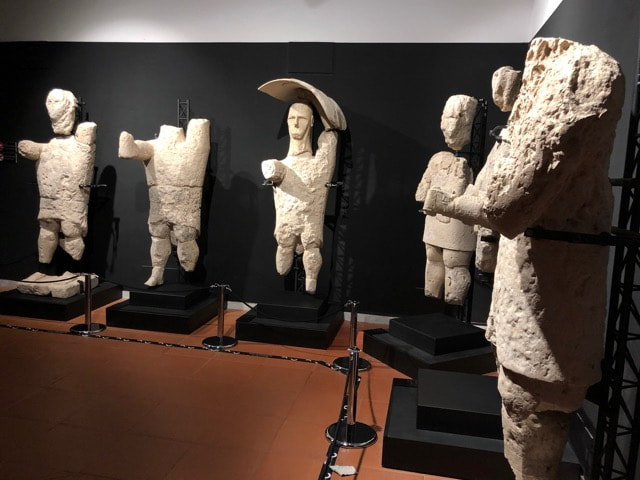 Fearsome warriors from 900 BCE But I bet our guests would have succeeded in making a peace treaty, and the giants would have joined us for a blow-out feast at our agriturismo L’Orto! 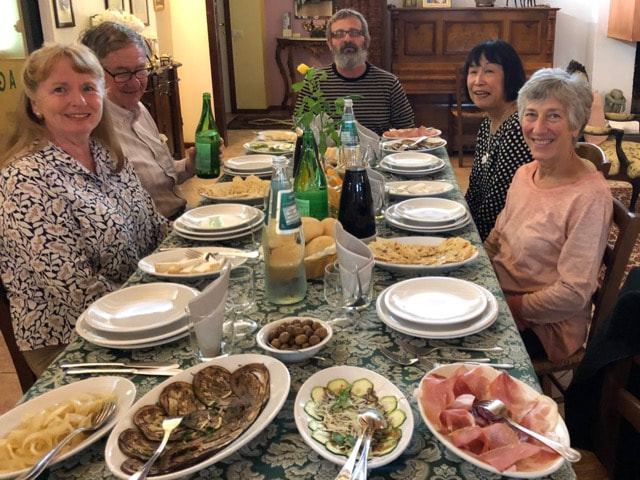 Every meal was a feast at Agriturismo L’Orto. Come on one of our small group tours so you too can glow with achievement and join our guests’ hall of fame. Choose your tour now: http://www.sapori-e-saperi.com/small-group-tours.html
If you landed here by chance and would like to be notified of future posts, you can sign up here. If you’d like periodic news about our tours and courses, sign up here. This blog was originally published on Slow Travel Tours on 11 November 2018. According to the Italian National Organisation of Cheese Specialists there are 643 different cheeses in Italy. Wikipedia puts the number in the United Kingdom at over 700. Counting cheeses could rival sheep for putting you to sleep. Yet talking about and eating cheese is spellbinding, and making it can be addictive. 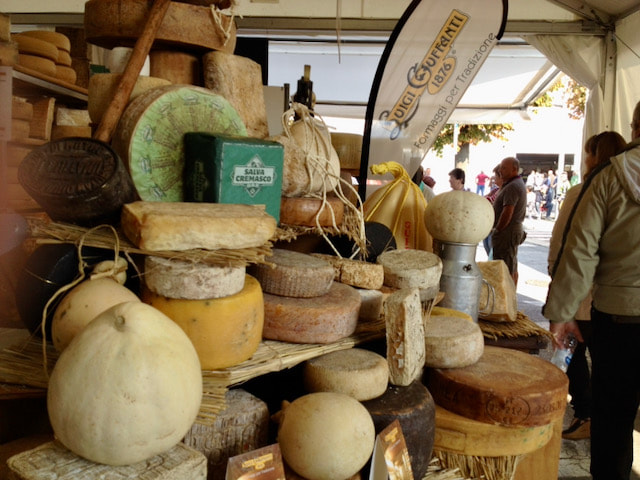 Just a few of the vast range of Italian cheeses at Slow Food Cheese, Bra, in 2013 What strikes me about the list of Italian cheeses is how many of them are traditional cheeses that have been made and eaten for centuries, some even for millennia. Scanning the list from the UK, I see lots of newly invented cheeses, many of them excellent I know from firsthand experience, but they haven’t yet stood the test of time. 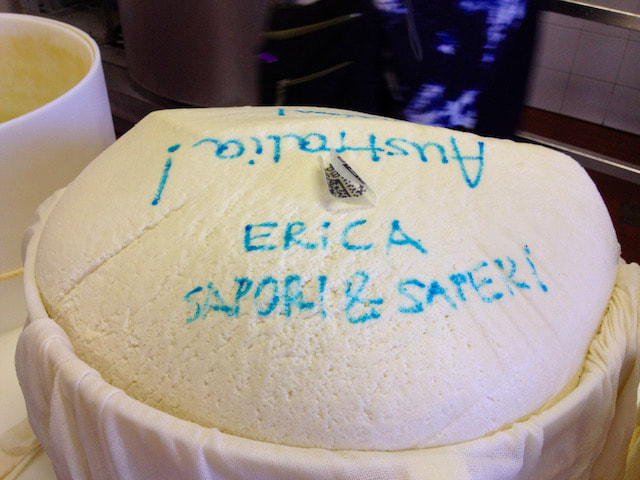 Food-grade ink is new, but a cheese similar to parmigiano from the same area is documented from Roman times, and it appears in recipes in one of my 17th-century English cookbooks There are many motives for inventing a new cheese: curiosity, marketing, ego, a mistake during production that turns out to taste good. Among the Italian cheesemakers I know, none of these factors influences them. They’re proud of their heritage and want to make the cheese their parents and grandparents made as well as they can. It’s as if they have a Platonic ideal of, say, pecorino which they’re aiming at. And they sell it as ‘pecorino’. If they package it, the label will give the name and address of the dairy, but the cheese itself is ‘pecorino’. 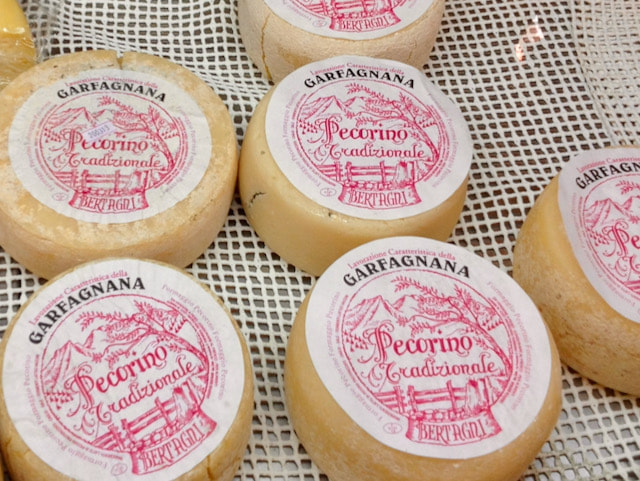 Pecorino is pecorino at Verano Bertagni’s dairy. 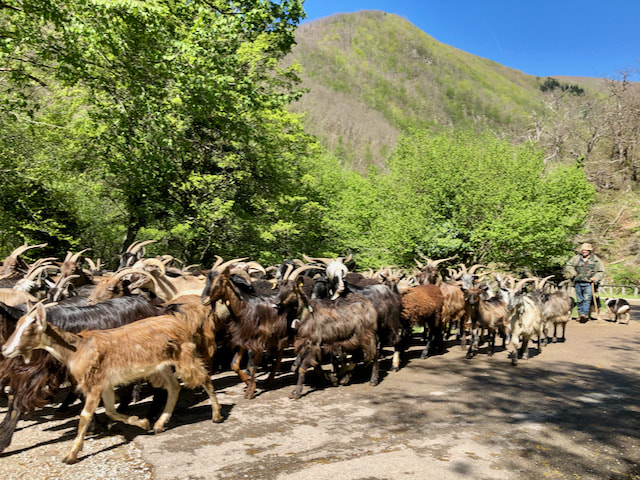 Vitalina says, ‘We've always been the goat people’… 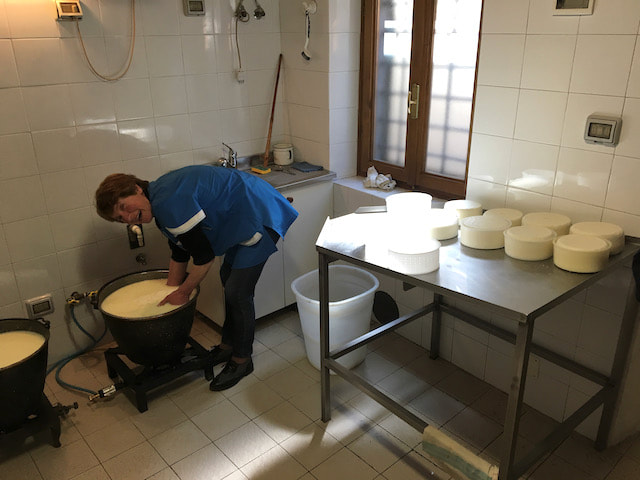 …and she still makes caprino (goat’s milk cheese). Why are there so many traditional cheeses? Geography and history account for much of the diversity. But I suspect so does that endemic Italian characteristic campanilismo, the conviction that everything within sight and sound of your own bell tower is best. You might occasionally eat cheese from elsewhere, but with a very few exceptions, you certainly don’t set up a dairy to produce it, and even less to give birth to your own invention. 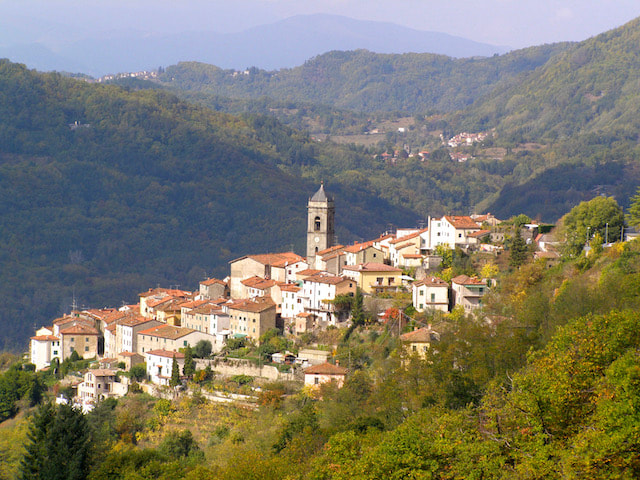 How could my bell tower not be best when it looks like this? (Photo: John Morrison) Very few people outside Italy realise we have this huge variety of cheeses most of which are produced only in a limited area. For example, Gorgonzola is produced only in parts of Lombardy and Piedmont in northern Italy. Parmigiano is made only in part of Emilia-Romagna. Mozzarella is produced only in southern Italy. The expert Gorgonzola producers have never made mozzarella, and vice versa. Sometimes I get a request for a cheese course including all four of these cheeses, and I have to say no. My courses are taught by cheesemakers who have been making their kind of cheese all their lives. To get to these experts we would spend all our time travelling up and down the country with no time left for our hands-on workshops learning to make the cheeses. For example: 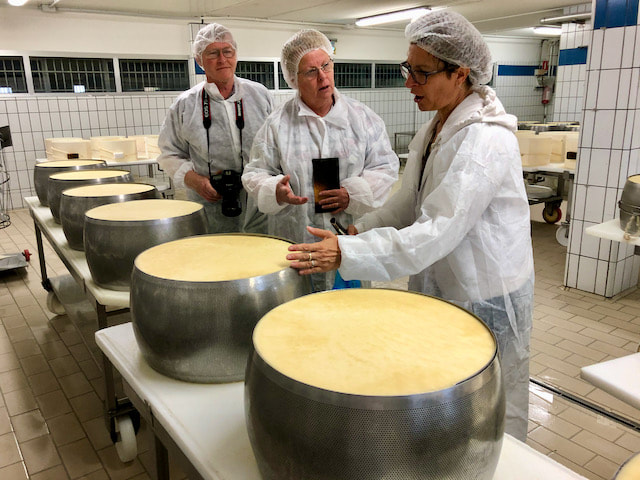 Here we are at Santa Rita Bio in the Province of Modena to learn how to make parmigiano Then, 45 minutes by car to Modena station. 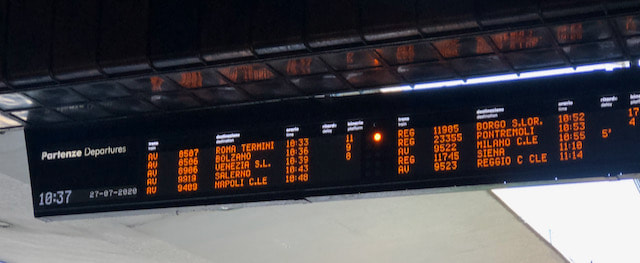 Five and a half hours from Modena to Salerno on the train and another hour to get to our dairy Prime Querce… 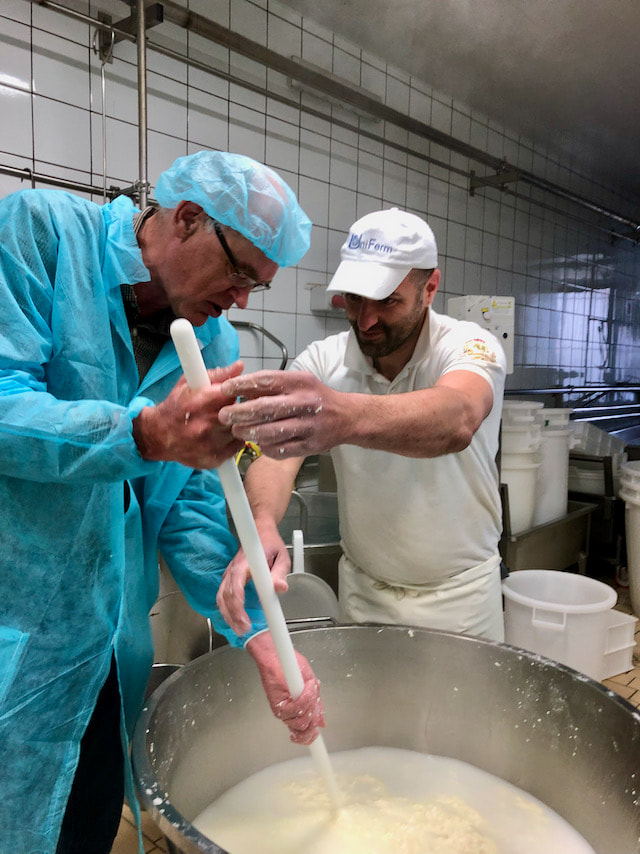 …where we begin five days of full-on immersion in mozzarella. No, no. Too much stress! To me, the distinctiveness of each region is one of the beauties of Italy. You have to go to a particular place to eat a particular type of food. Massimo Bacci, who is one of the norcini (pork butchers) who teach my salumi course, always says: ‘If you could get my salami by mail order anywhere in the world, half the joy of travelling would disappear.’ I would add that the flavour of what we eat is influenced by our surroundings. You will never taste a better mozzarella than the one made six hours earlier in a nearby dairy which you enjoy with friends of the cheesemaker in Campania with the fragrance of the Mediterranean maquis in your nostrils, the sawing of cicadas in your ears and the Mediterranean Sea glittering in the distance. 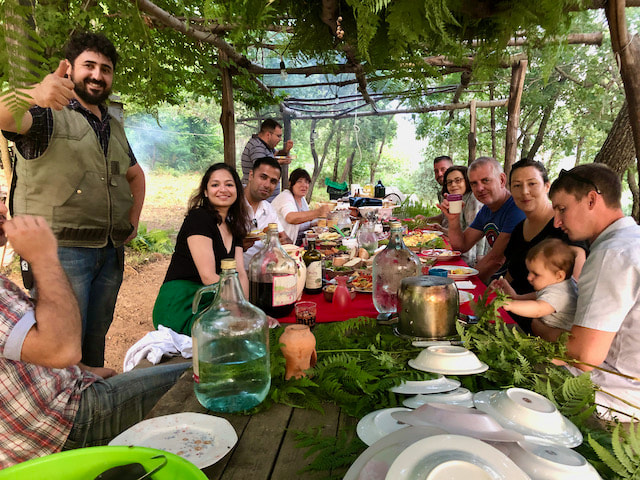 I’m writing this blog to coincide with the British Cheese Weekender 2021, a series of live online events presented by cheesemakers, cheesemongers, cheese maturers and chefs in the UK. Click here to see what’s on today. If you landed here by chance and would like to be notified of future posts, you can sign up here: http://eepurl.com/geSMLv
If you’d like periodic news about our tours and courses, sign up here: http://eepurl.com/hVwz6
When you come on my tours I hope you’ll feel as if you’ve tumbled down the rabbit hole into a Wonderland of strange language, landscapes, white rabbits, mad hatters and cheshire cats. Relax and bask in another culture. There will be many green bottles saying ‘DRINK ME’ and food saying ‘EAT ME’.
The strangest of my tours is Celebrating Sardinia. Sardinia is only barely Italy, so don’t assume because you’ve explored the mainland, you also know that bean-shaped island off its west coast.
The tour is timed to enjoy the festivities for the patron saint of Sardinia, Sant’Antioco. His tomb is in the cathedral of the town of Sant’Antioco on the island of the same name, now linked by a causeway to the southwest corner of the island of Sardinia. The celebration takes place two weeks after Easter.
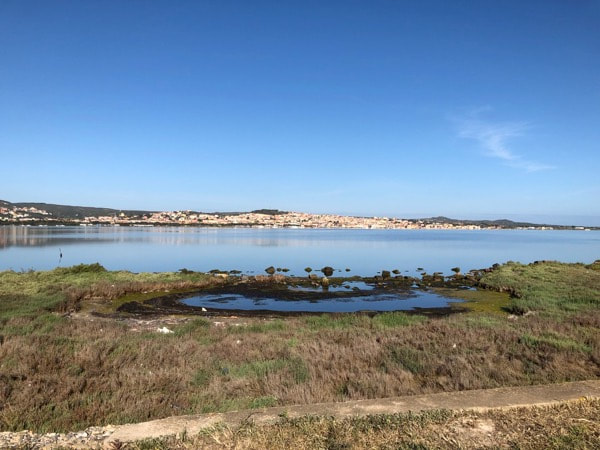
Sant'Antioco from across the lagoon
Stefano Castello welcomes us with a tune on the launeddas, a bagpipe without a bag, found only on Sardinia. Notice his cheeks.
The opening procession of the festival immerses you in the all-encompassing strangeness of the Sardinian Wonderland. There are many other traditional festivals in Italy, but here you have the sense of the past spilling over into the present. The fabric and needlework to make the costumes, the woodworking and decoration of the carts and the oxen which pull them, the music and the dance, all these skills were passed on to the present generation by parents and grandparents. They didn’t disappear only to be insecurely resurrected from hearsay, books and photos.
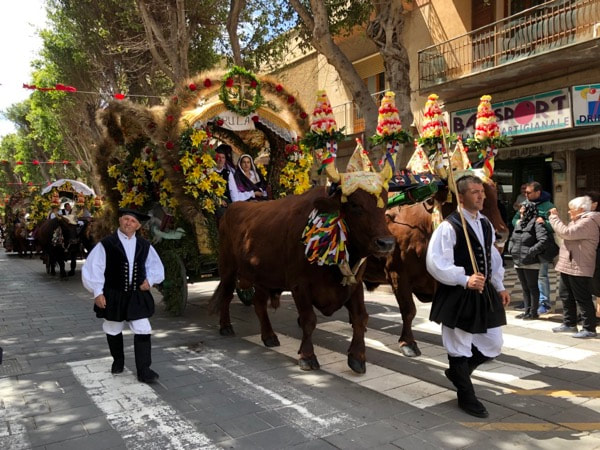
For the opening procession Sardinians come from the whole island in their individual village costumes and decorated oxcarts.
I think Sardinia is the only place where there are more sheep than humans. Giulio Basciu is one of the dwindling number of Sardinians living a traditional rural life.
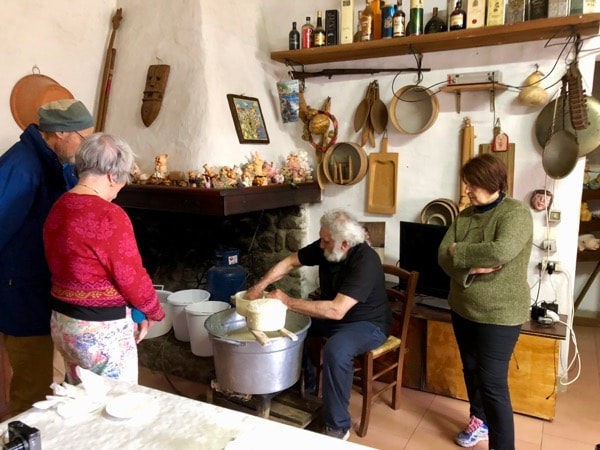
Giulio makes pecorino with the milk of his own sheep.
Antonella Ajò learned to pot because she wanted to make ceramic models of every romanesque church in Sardinia. She achieved her goal, but having became addicted to the craft, she can’t stop.
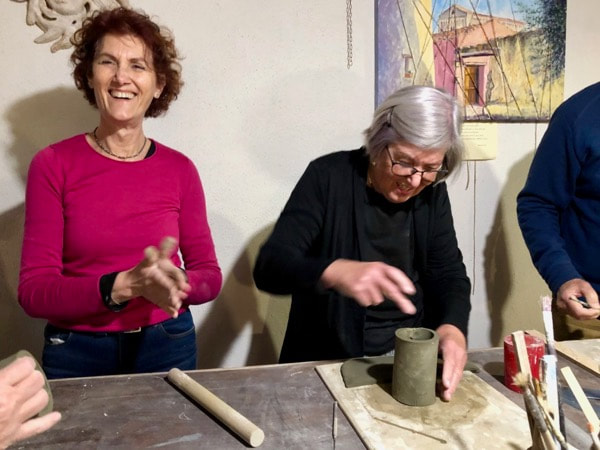
Antonella is such a good teacher that even if you thought you couldn’t make anything, you’ll be surprised at your achievements.
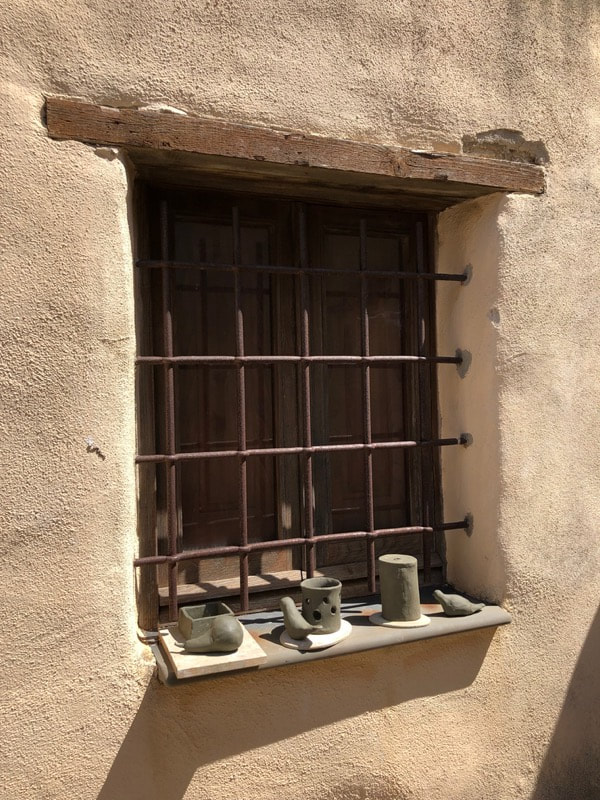
Look what we made!
Something else you can only find here is bissu, a fibre made from the beard of a mollusc.
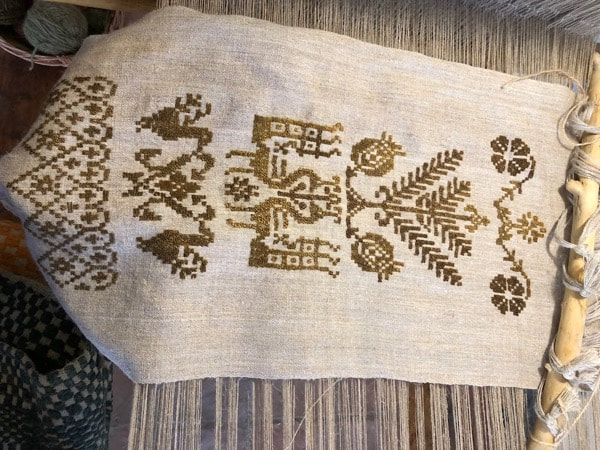
It shimmers like gold in the sunlight.
It used to be harvested from the bivalve Pinna nobilis, which was becoming extinct and was protected in 1992. Ariana Pintus has found another abundant shellfish whose beard has the same properties. It’s painstaking work cleaning and spinning the fibres.
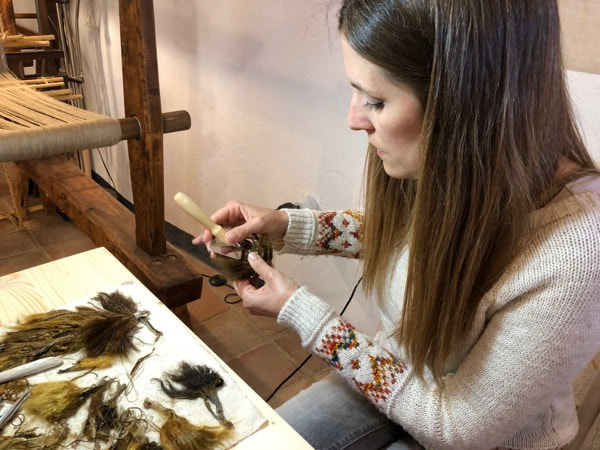
Arianna carries on a tradition that many women of Sant’Antioco knew how to do.
It’s time for one of those green bottles with the ‘DRINK ME’ label.
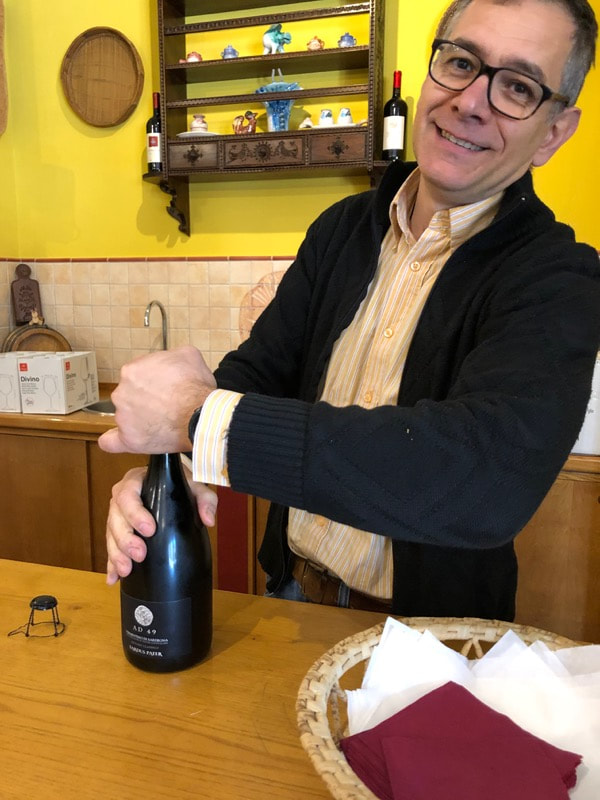
Alberto uncorks the bubbly made by the classic champagne method in the winery of Sant’Antioco.
Not many places have salt pans you can visit to find out how salt gets from the sea to your table.
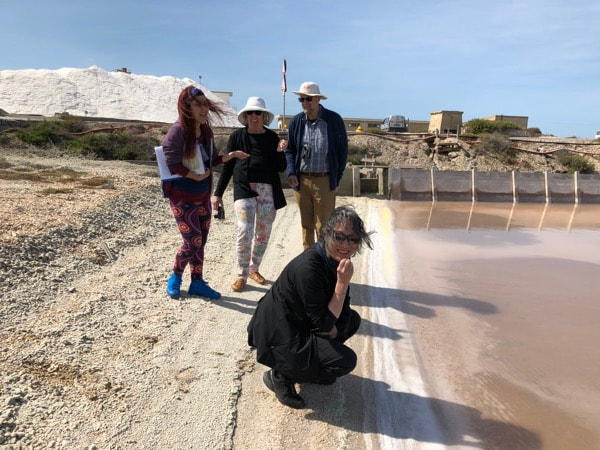
Look at that mountain of salt behind us!
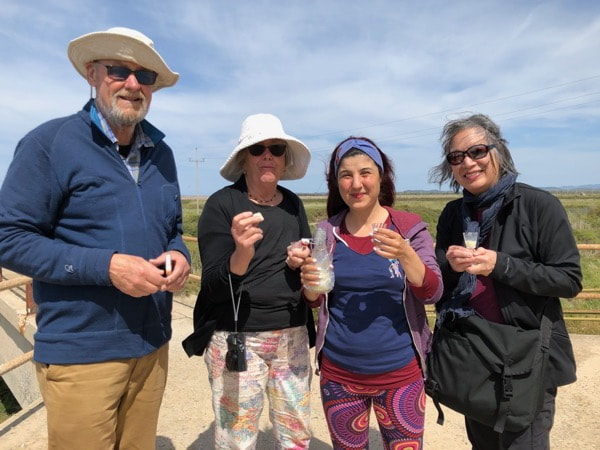
Our guide Lisa (3rd from L) insists our tour isn’t complete without tasting her homemade limoncello.
You definitely won’t find delicious culurgiones anywhere else.
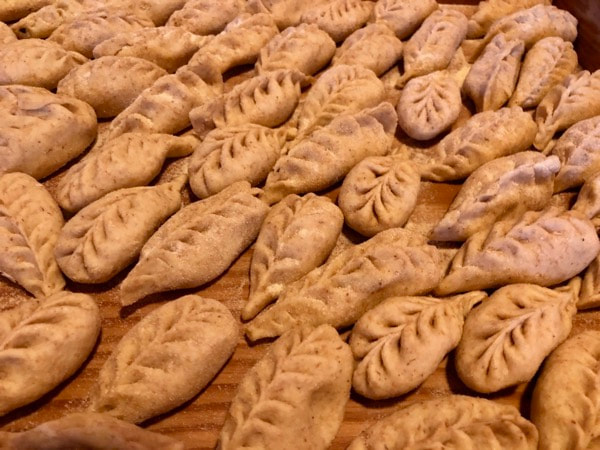
We made this potato-filled pasta shaped like ears of wheat. The flour was stone-ground old varieties of biodynamic grain.
For sure one of the highlights of the tour, and an experience it would be hard to find anywhere else, is making bread with Anna Marras and her friends. Antonella, the potter, told me about this group of retirees who amuse themselves by keeping alive their old traditions and teaching them to the young.
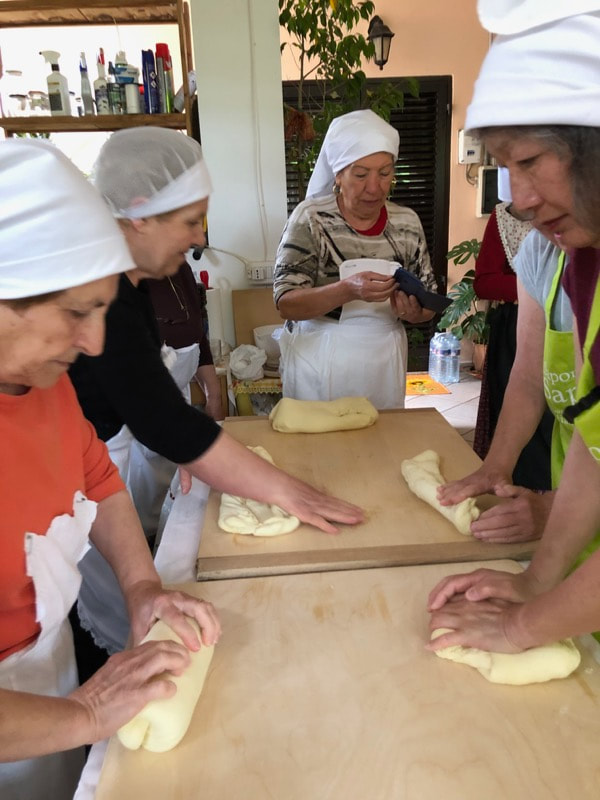
That’s Anna at the far end.
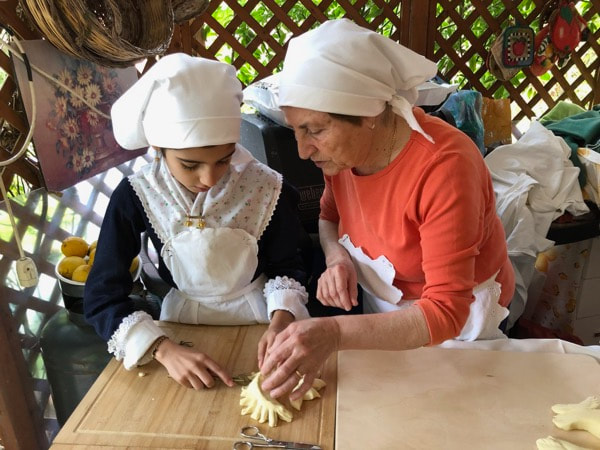
This is how you start.
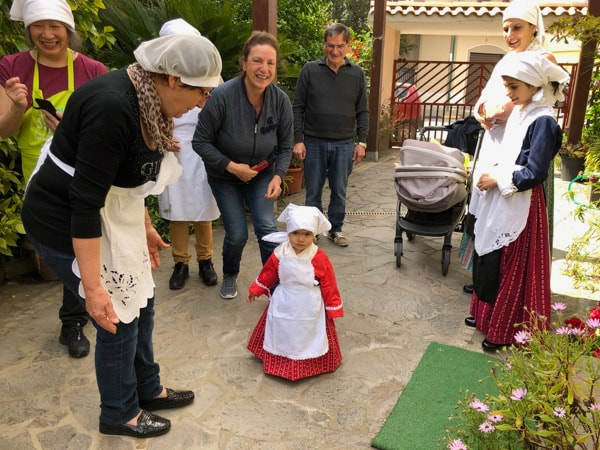
Still a bit too young to learn, but she’s already got her party dress.
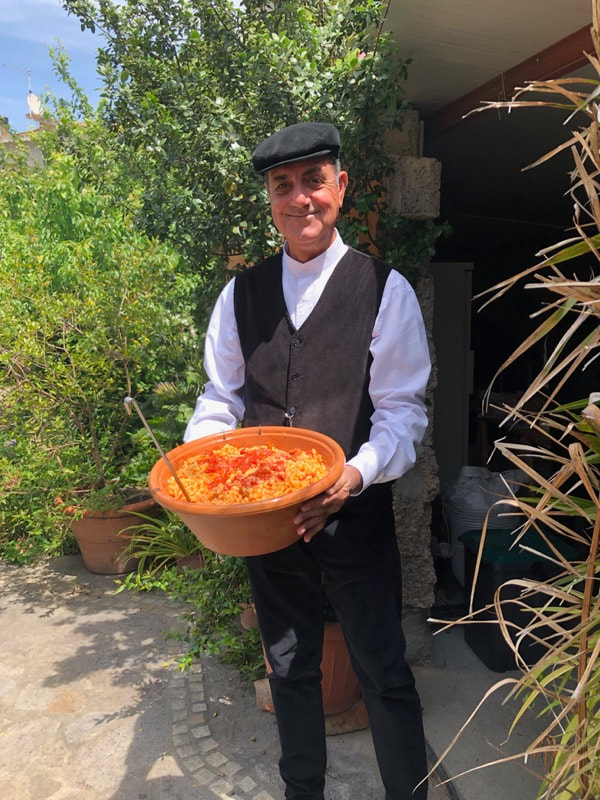
The men do the heavy work!
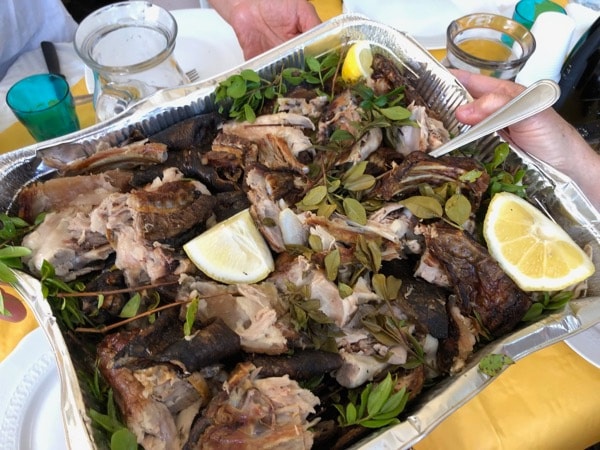
This porceddu (piglet) roast in a wood-fired oven definitely says ‘EAT ME’.
We were blown away by their hospitality.
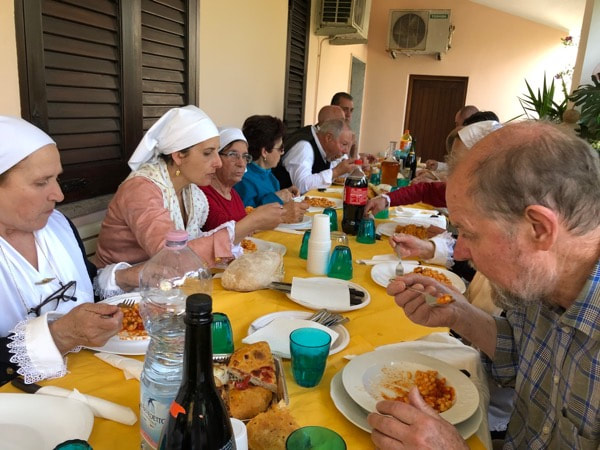
I’d only asked for a bread lesson and we got a feast.
Three days into the tour fisherman Mauro Pintus, on whose boat we spend a blissful day on the lagoon, phoned to say he couldn’t do Wednesday, but how about Friday. The reason? For six months they’d had tickets for a pop concert in Milan, but he’d totally forgotten about it. I managed to swap Friday’s activities to Wednesday. And the weather was much better on Friday. Thank you pop concert!
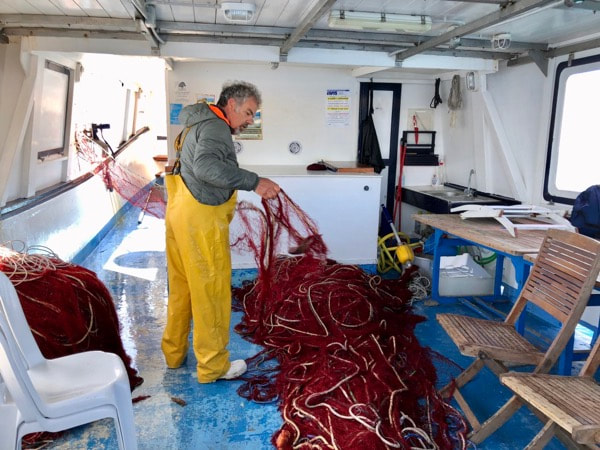
Mauro reels in the net.
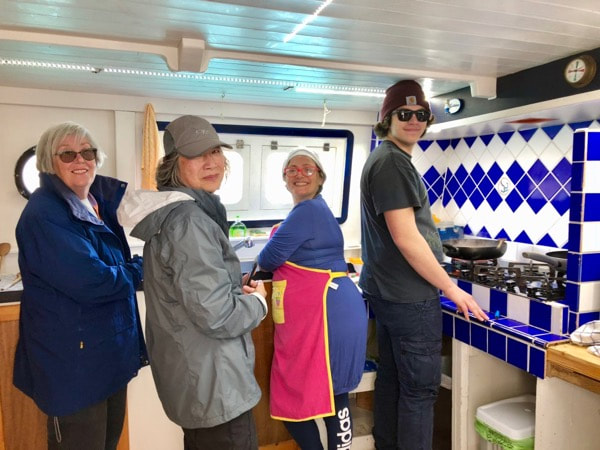
We congregate in Roberta’s galley for a preview. Her son Alessandro likes cooking better than fishing.
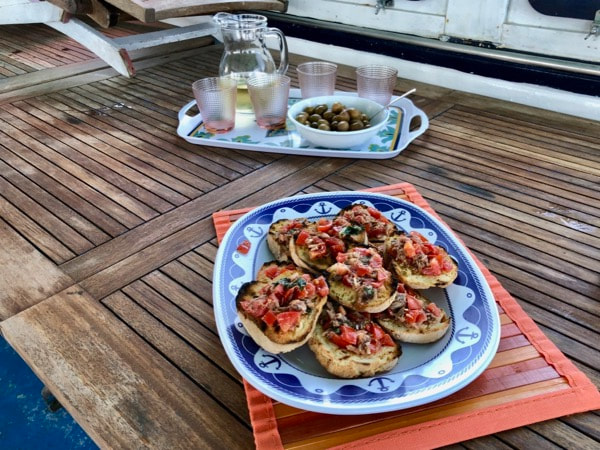
‘EAT ME’ is writ large here.
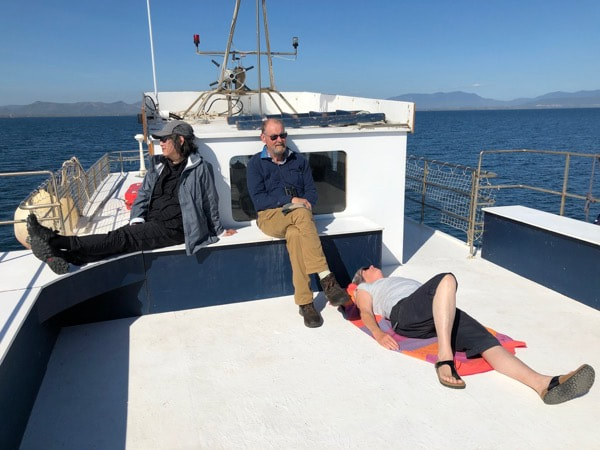
After an abundant lunch, we need a siesta.
On our last day we go to see another unique prehistoric Sardinian structure: a Bronze Age nuraghe built by a civilisation that endured from 1700 to 200 BC. They played the launeddas that Stefano demonstrated on the first day of our tour.
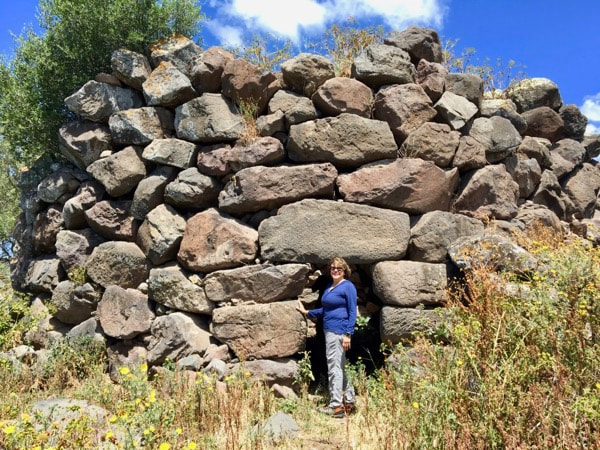
This is only the bottom half.
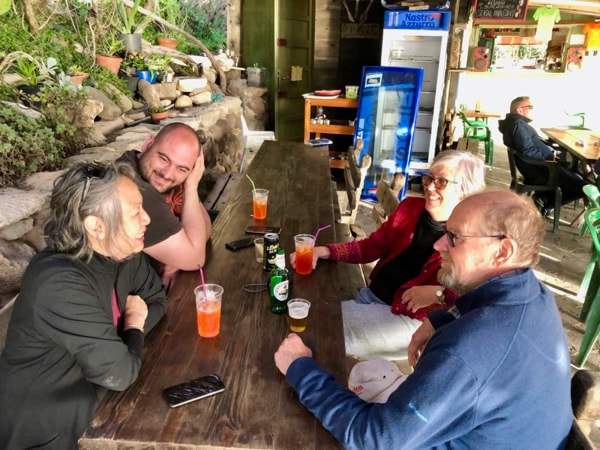
Spritz at a seafood shack.
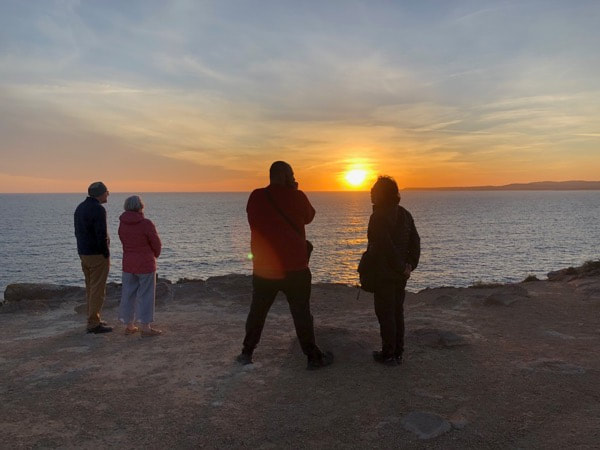
The sun sets on a tour full of strange things and wonderful people.
I'm repeating this blog I wrote two years ago because, if it weren't for Covid-19, we would have been Celebrating Sardinia right now. Next year's tour is already confirmed, and there are only three places left. Why not join us for an extraordinary experience from 29 April to 8 May 2022? You'll find dates for 2023 and more details about the tour here.
If you can't wait until next year to travel to this Wonderland, the Giants of Sardinia tour takes place in October, by which time travel to Italy may be possible. If not, you may apply your deposit to another tour or have a refund.
If you landed here by chance and would like to be notified of future posts, you can sign up here http://eepurl.com/geSMLv
If you’d like periodic news about our tours and courses, sign up here http://eepurl.com/hVwz6
This blog was originally published on Slow Travel Tours on 28 June 2019.
This blog was originally published on Slow Travel Tours on 28 January 2017. Did you know that olive oil is the only common cooking oil that is the juice of a fruit? All the other oils we use in our kitchen come from seeds: sunflower, rapeseed (canola), peanut and grapeseed. This realisation leads directly to another question. Would you cut an orange, leave it on the counter for a week and then squeeze and drink the juice? Would you step on an apple, leave it on the table for three days and then eat it? Yet that’s what happens to many olives before they’re pressed to extract olive juice. I’ve tasted and written a lot about olive oil, but this idea had completely escaped me until I met Elisabetta Sebastio last year. She’s a professional olive oil taster both for Italian Chambers of Commerce and international olive oil competitions. We ran our first full-day olive oil class during my Autumn in Tuscany tour in November 2016 (now we run a full course on the subject of olive oil: Olive Oil: Tree to Table in Tuscany). It was a revelation for all of us. We gathered around her kitchen table. She taught us how the professionals taste and rate oil. We tasted eight olive oils. 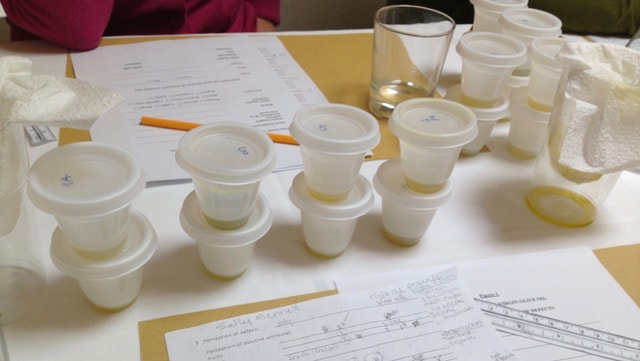 Our game for the morning (Photo: Sally & Wilfrid Mennell) The first was a surprise and I don’t want to ruin the impact by telling you what it was. Then there were four new-season oils: one from Sicily, two from Tuscany and one from the Abruzzo. Some people liked the tomato scent of the Sicilian one, others the bitter piquancy of the Tuscans. 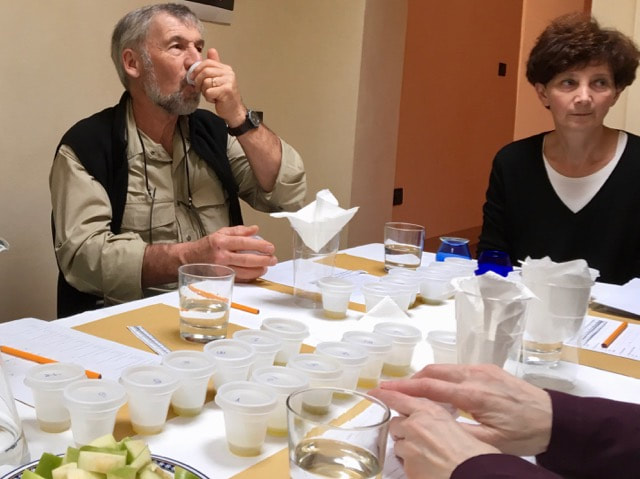 Can you smell tomato? Lots preferred the less in-your-face qualities of the Abruzzese. Under Elisabetta’s guidance it was so easy and we were proudly feeling like experts when we started on the three defective oils. Wow! It was so clear that they didn’t measure up, and we could describe what was wrong with them: rancid, vinegary and fusty. We didn’t want to put them in our mouths. You’ll taste lots of mildly rancid oils in restaurants due to poor storage in clear bottles in the warmth. There were more revelations. Contrary to popular belief, true extra-virgin olive oil has the highest smoke point of any vegetable cooking oil. Another fact some people don’t realise is that it deteriorates with every passing day, even in a sealed bottle. If you’ve got some excellent oil, carpe diem. It will be worse tomorrow. But olive juice isn’t just for cooking. In Italy it’s mainly used as a condiment, like salt and pepper. This got us thinking about which olive oil goes best with which foods. Elisabetta had devised a lunch to demonstrate the classic pairing of regional dishes with an oil of the same region. 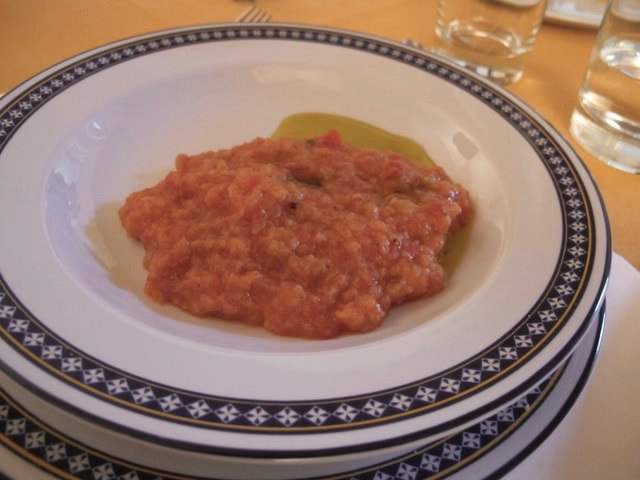 Tuscan pappa al pomodoro with Tuscan extra-virgin olive oil (Photo: Sally & Wilfrid Mennell) We got to help prepare orecchiette (an ear-shaped pasta from Puglia) with an artichoke sauce seasoned with extra-virgin olive oil from Puglia. 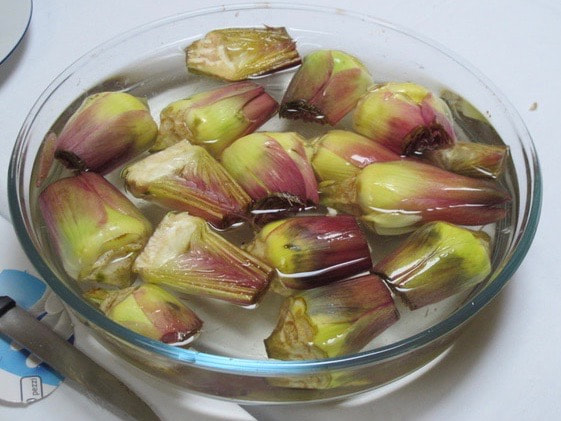 We learned how to remove the outer leaves to reveal the tender artichoke hearts. (Photo: Sally & Wilfrid Mennell) 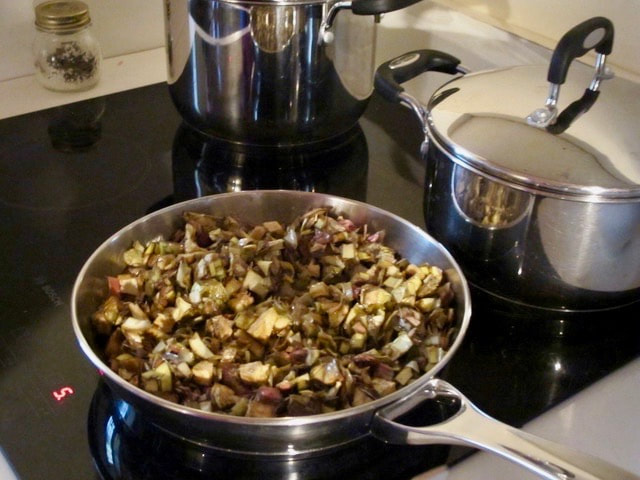 Artichoke heart sauce with extra-virgin olive oil from Puglia (Photo: Sally & Wilfrid Mennell) Sadly, we ran out of space in our stomachs before we could taste all the different dishes Elisabetta had prepared. I took another group to her home in December. One of them loved chocolate and Elisabetta assured me she could source some olive-oil flavoured chocolate. The platter of chocolates was beguiling and they tasted fantastic. She had made them herself! 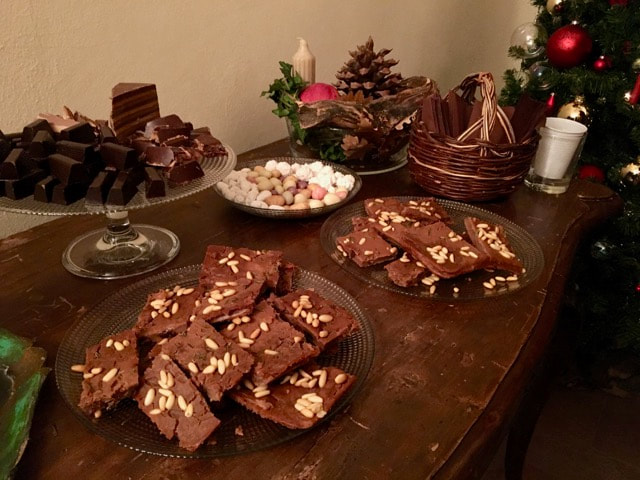 Elisabetta’s chocolates and castagnaccio with olive oil Join me on the course Olive Oil: Tree to Table in Tuscany from 18–23 November 2021 and meet the amazing Elisabetta and have fun with olive juice. If you landed here by chance and would like to be notified of future posts, you can sign up here. If you’d like periodic news about our tours and courses, sign up here. 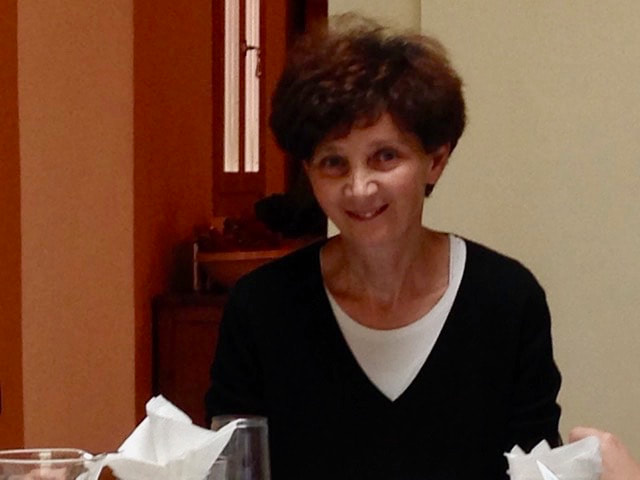 The multi-talented Elisabetta (Photo: Sally & Wilfrid Mennell) This blog was originally published on Slow Travel Tours on 29 December 2013 Sapori e Saperi means ‘flavours and knowledge’, and on my tours guests enter a pleasant and gentle ‘school’ of artisan food. I’m always searching for new producers of the best of Tuscan produce. The results of my detective work are often surprising. Sometimes I go looking for cheese and I find wool. 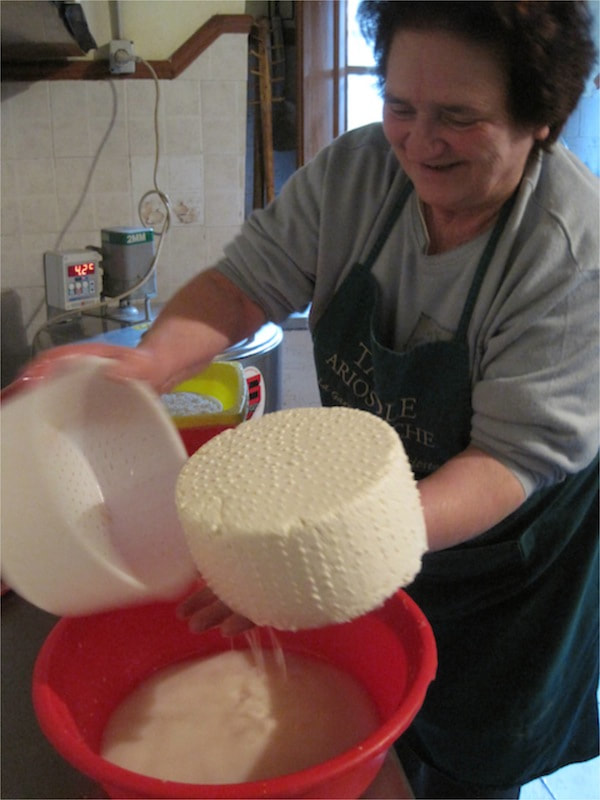 Gemma makes pecorino with the milk of… 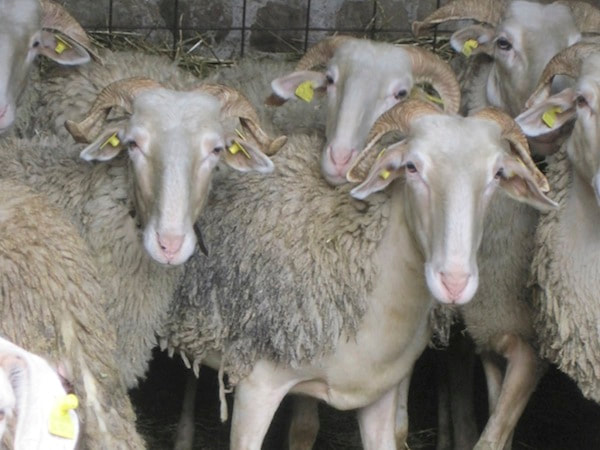 …her Garfagnina Bianca sheep, part of a project to preserve the ancient breed. 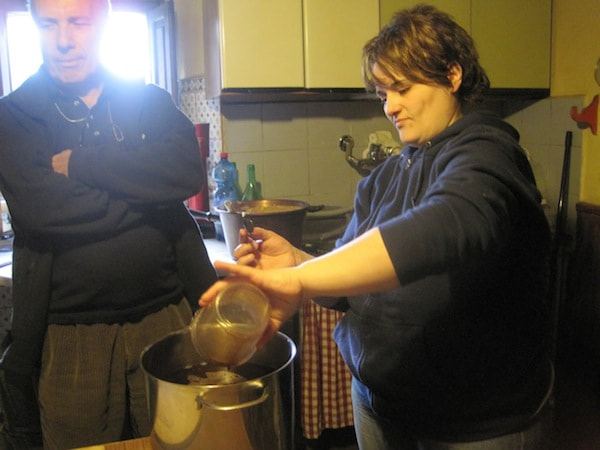 Her daughter Ombretta learned to dye their wool with natural dyestuffs… 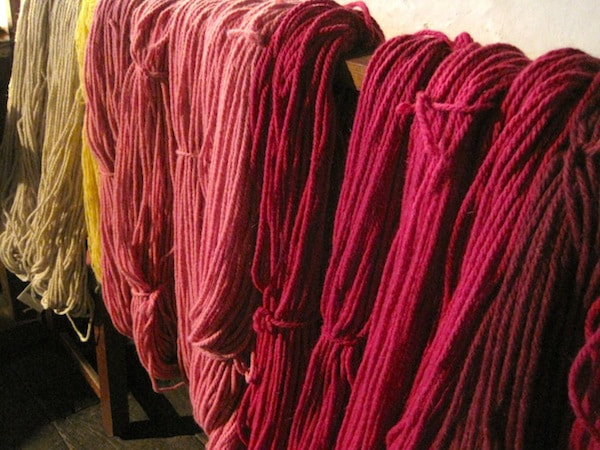 …to produce these subtle colours. 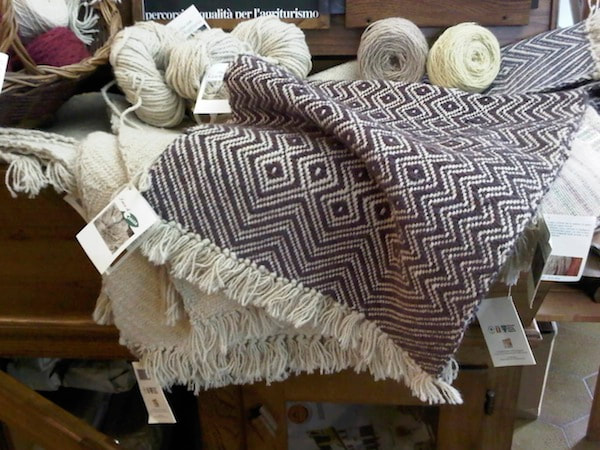 She found skilled local weavers and sells their work. More about a day on the Cavani farm. Or it’s squashes I’m after and I come up with hemp (yes, cannabis, but not the smoking kind). 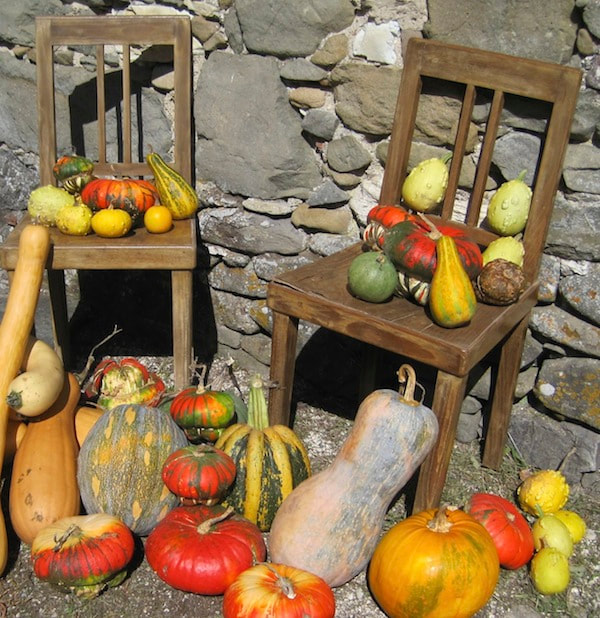 Squash display at Sagra della Zucca (squash festival) 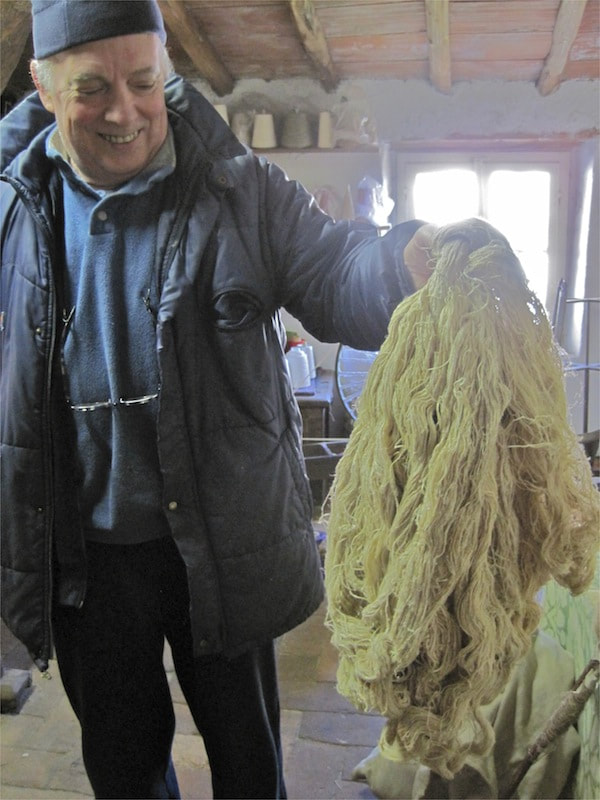 I found Romeo at his textile stall and later in his attic where he showed me antique hemp… 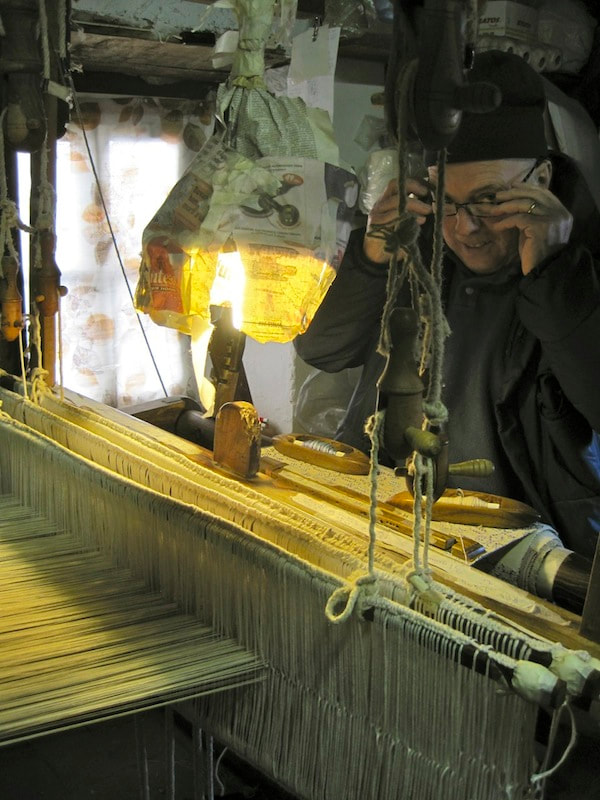 …which he weaves on his century-old floor-loom into… 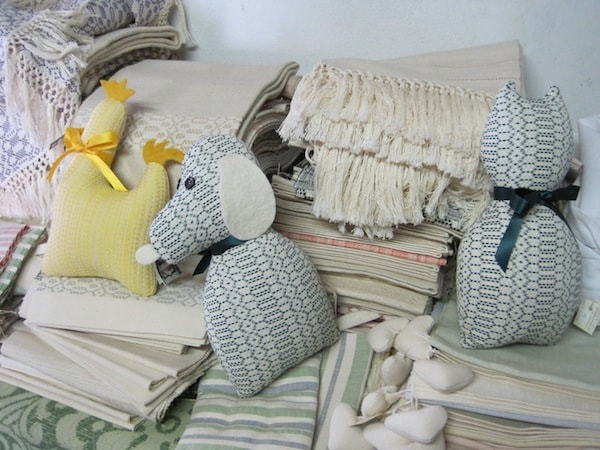 …household linens that his wife Nada finishes. Read more about Romeo and Nada here: Weaving a Life of Happiness And there was the day I was sitting innocently enjoying lunch at Il Vecchio Mulino… 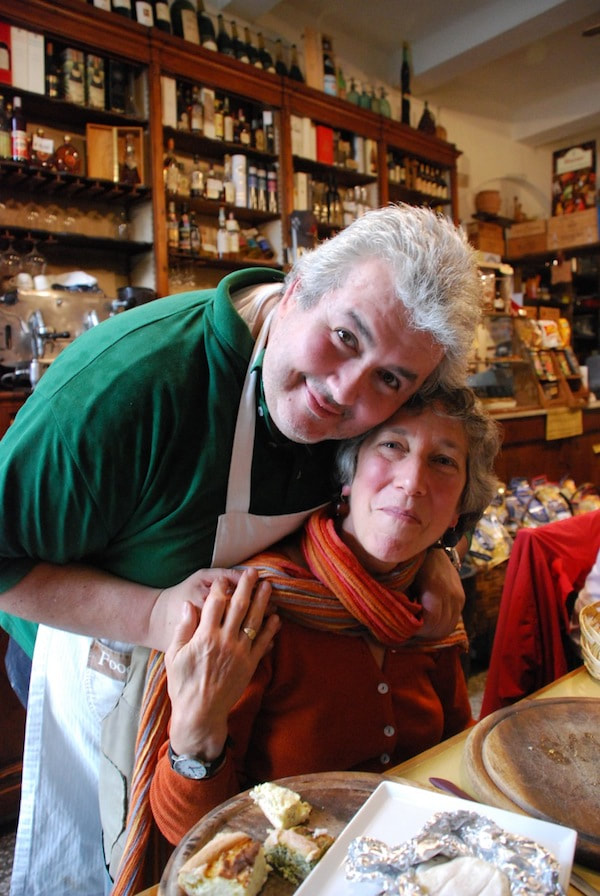 Owner Andrea is happy that I’m enjoying my lunch. when the owner introduced me to two brothers who run a scarf mill where they weave silk and cashmere scarves on traditional Garfagnana floor-looms for international fashion houses. They begged me to bring my clients to see how they had rescued a dying craft and made it relevant to the modern world. 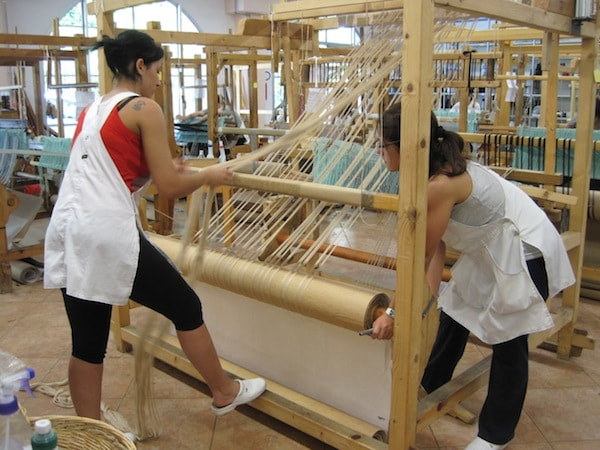 Artes weavers warping a loom. 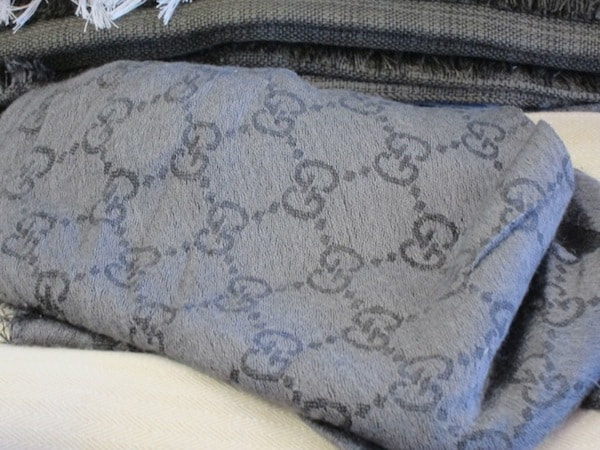 Handwoven cashmere scarf My weaver friend from Cambridge came to visit and was inspired by Stefania who rears silkworms and runs silk workshops for schoolchildren, because her grandmother and grandmother-in-law raised silkworms and she wants today’s children to know about their past. 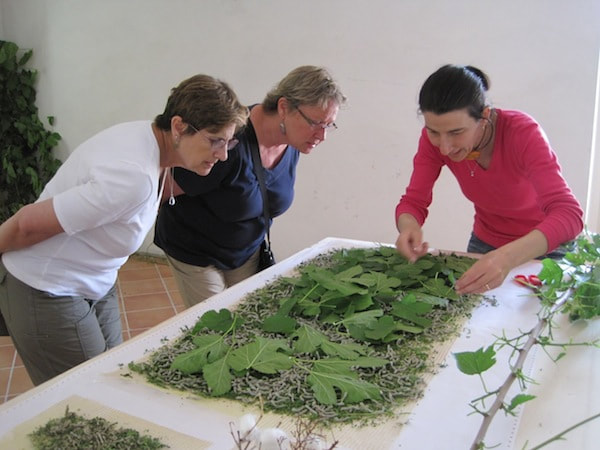 Sapori e Saperi guests help feed Stefania’s ravenous silkworms. 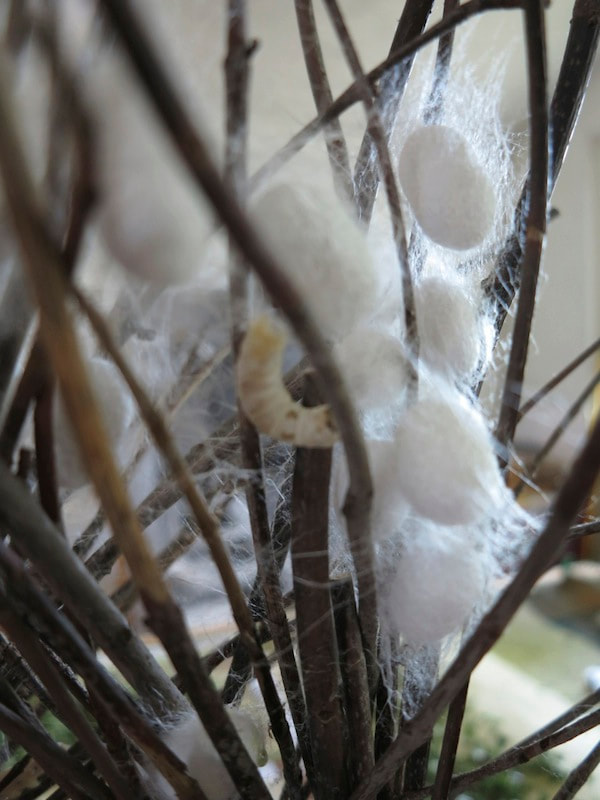 Silkworm spinning its coccoon Several of my tours include a lesson with Paolo the village baker (more about Paolo) in a village that hosts a farro festival where we get to eat all the traditional dishes made with that primitive wheat. There on his dad’s front patio I met Teresa Bertei and her friends spinning and knitting. 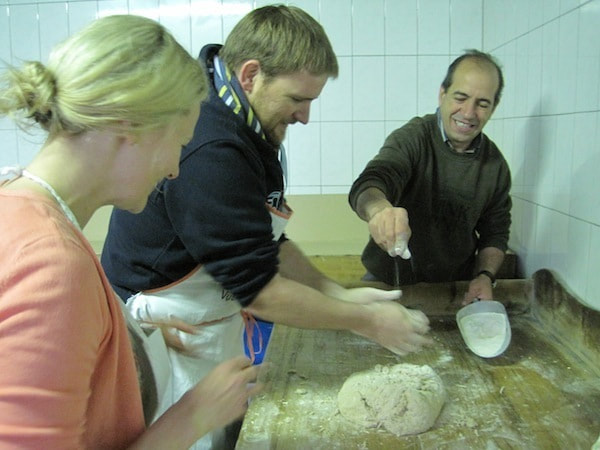 Baking bread with Paolo 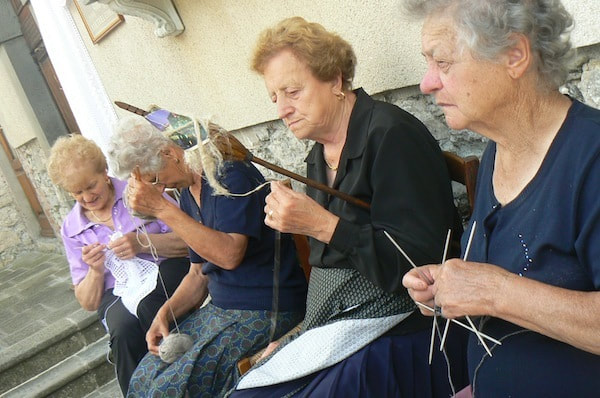 Teresa and friends probably wishing they were helping us eat the farro. 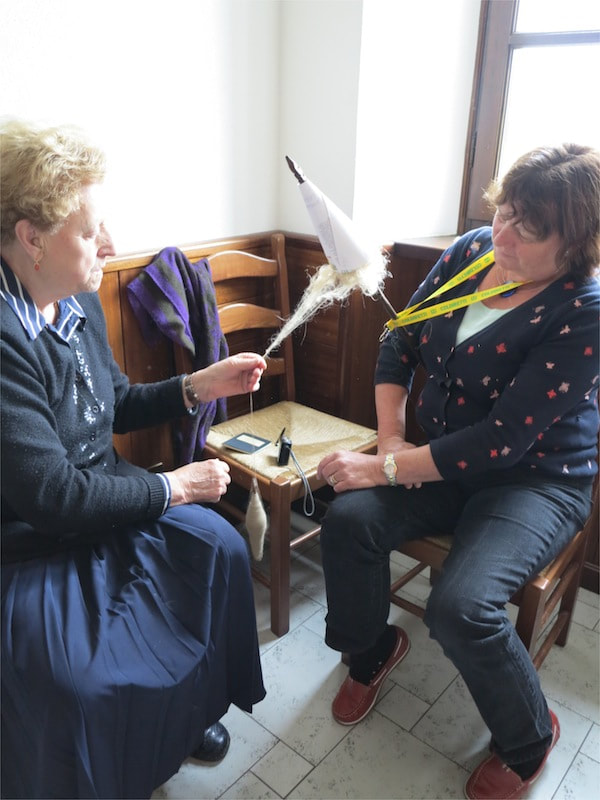 Now Teresa teaches my guests the art of spinning with a drop spindle. Soon I had a network of textile artisans to interweave with my food producers. My guests on each tour give me more suggestions of other things they would have liked to have done if only there had been time. Finally the fabric was stretched to its limit, and I’ve added an extra day this year. After all, we still need time to relax at a cafe and enjoy a gelato. 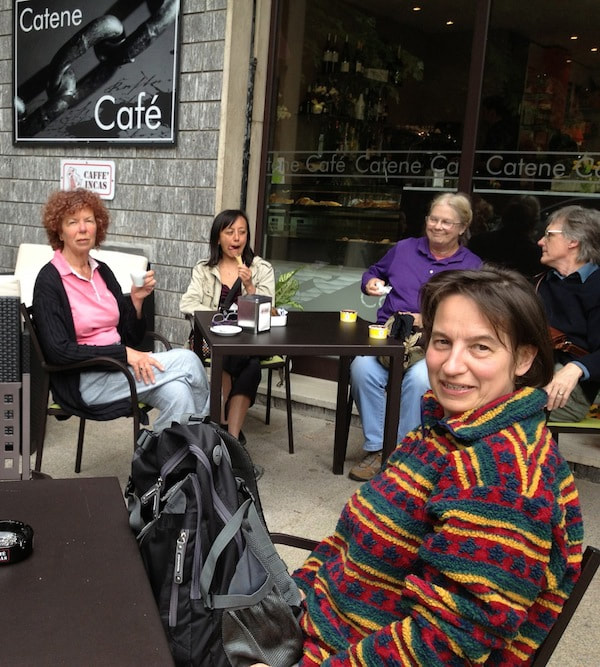 Sitting in the sun enjoying Paolo’s artisan gelato This element of the serendipity is a feature of Slow Travel. If you stay in one place long enough, you find all sorts of things you weren’t looking for (read more about how I research my tours), and this explains why I offer ‘Tastes & Textiles’ tours among my culinary adventures. The next ‘Tastes & Textiles’ tours will take place in September 2021 and May, June and September 2022. Full details here.
If you landed here by chance and would like to be notified of future posts, you can sign up here. If you’d like periodic news about our tours and courses, sign up here. By Alison Goldberger 2020 is definitely a year none of us will ever forget, that's for sure. It all started off so promisingly with lots of excitement about meeting all of you who had booked on a tour or course! Of course we all know how it ended—with a year very difficult for a small tourism business. Although we were disappointed we had to cancel many tours and didn't get to meet you, we were buoyed by all your messages, interaction on our social accounts and hope you enjoyed the virtual tours we ran. And of course, it wasn't ALL bad, and Erica and I have survived the year in good health! So we'll start our review at the beginning, before we had even heard of the virus that would characterise the year... January 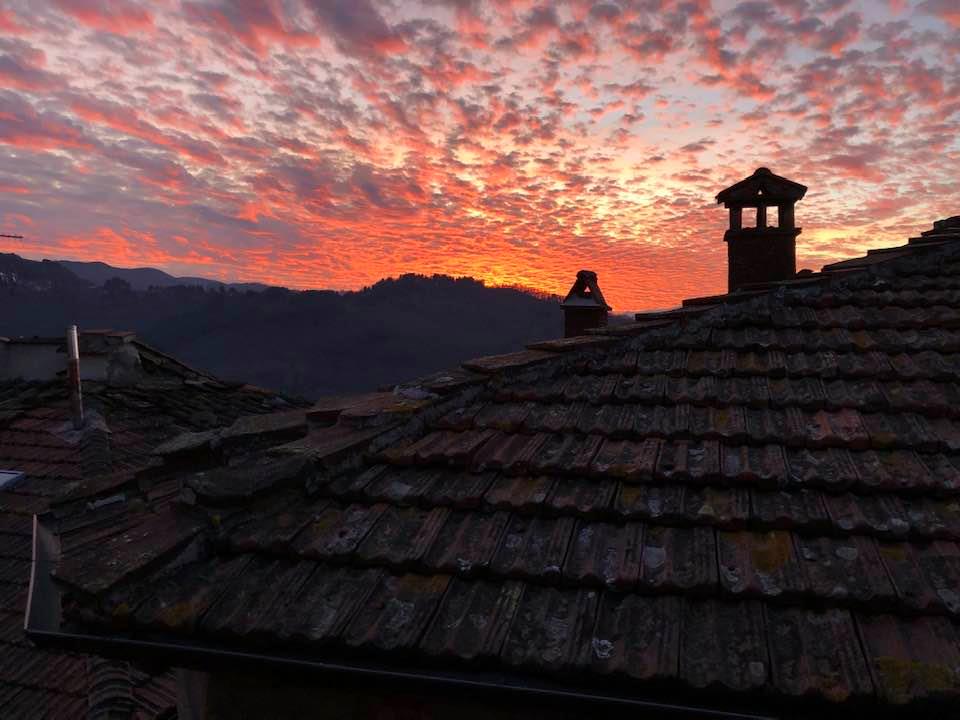 The view from Erica's window One of our first posts on Facebook was this stunning photo taken from Erica's window. She captioned it: 'The view from my window. Must be a good omen for 2020!' It makes me laugh a little now looking back at this. 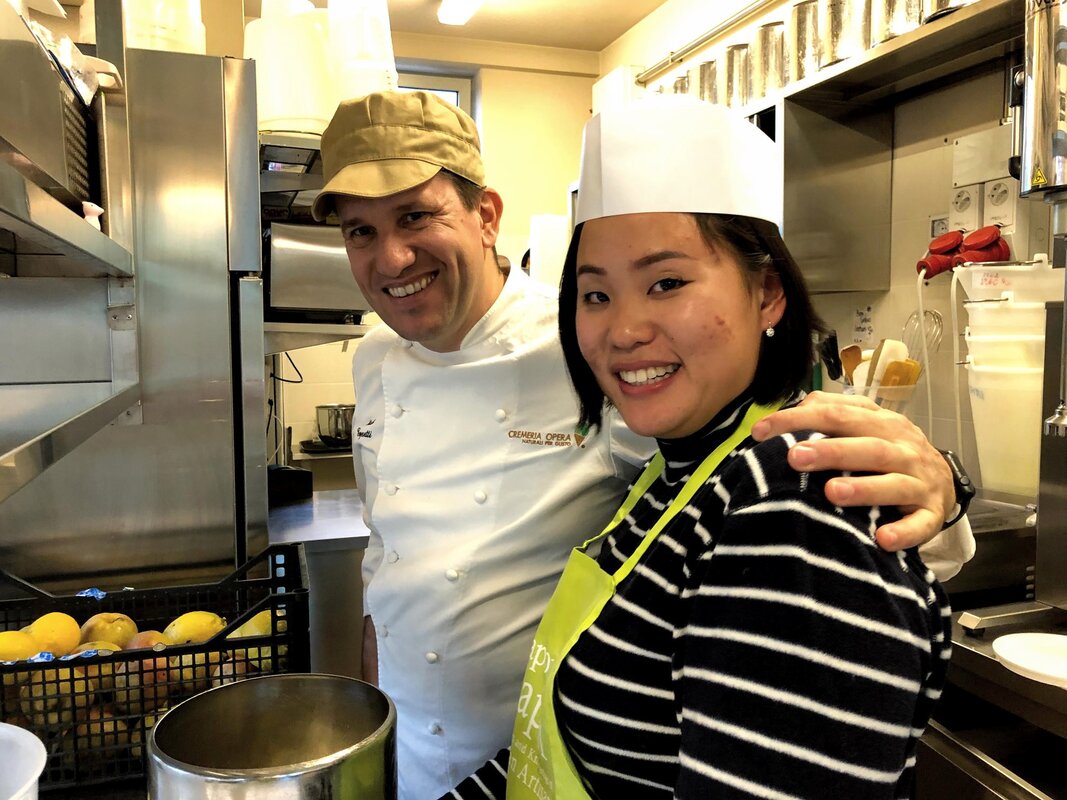 Mirko and Sorravee 'Gin' Pratanavanich during the first course of the year As I said in the introduction, 2020 started off great! The Art & Science of Gelato course got into full swing and we welcomed the super talented Sorravee 'Gin' Pratanavanich. Gin had grand plans, after learning with us she was due to head off to take up a chef internship at a hotel in Abu Dhabi. Looking ahead, Gin would like to open a pastry shop and gelateria in Bangkok. 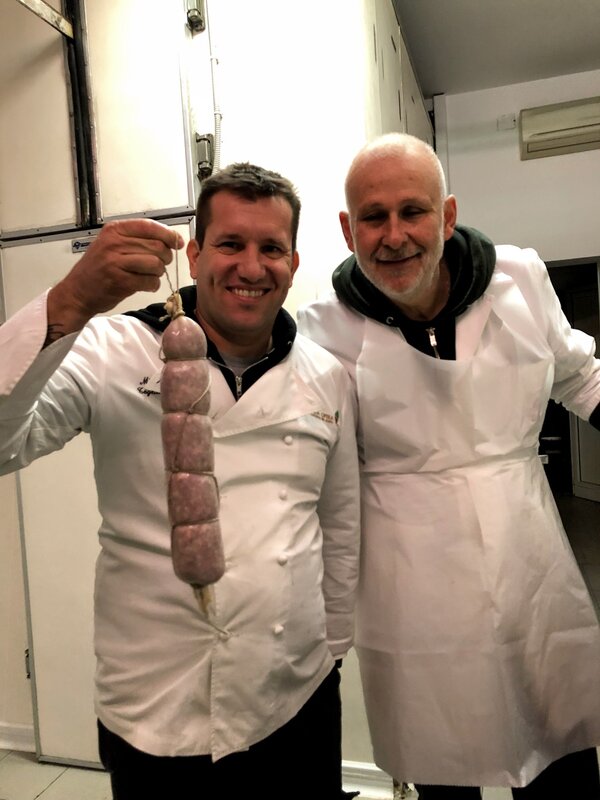 When gelato met salumi... Mirko and Massimo! We were also delighted to be able to run the Advanced Salumi Course Tuscany in January. Two of our artisans met during this course, Mirko who leads the Art & Science of Gelato course learned how to make salami from artisan norcino Massimo Bacci. 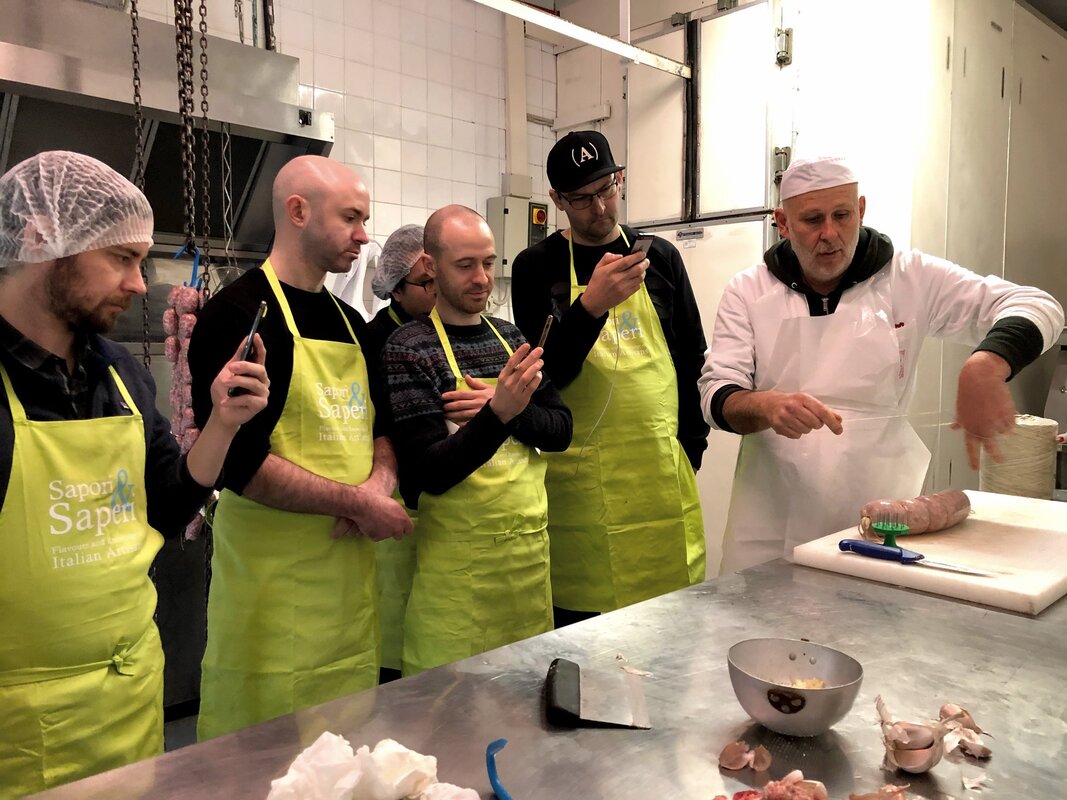 Recording every piece of information shared by Massimo Bacci Mirko wasn't the only one learning however. We met lots of interesting participants during the January Advanced Salumi Course Tuscany. Here we see them learning all about knots. Knots are important to hold things in place and to squeeze air out. To produce a nice looking product, you need to tie tidy knots. And as you can see, our participants were taking this very seriously! On the blog in January we also shared a beautiful piece by Lin Hobley about her experiences of the Tastes & Textiles: Woad and Wool tour. Read it here. February 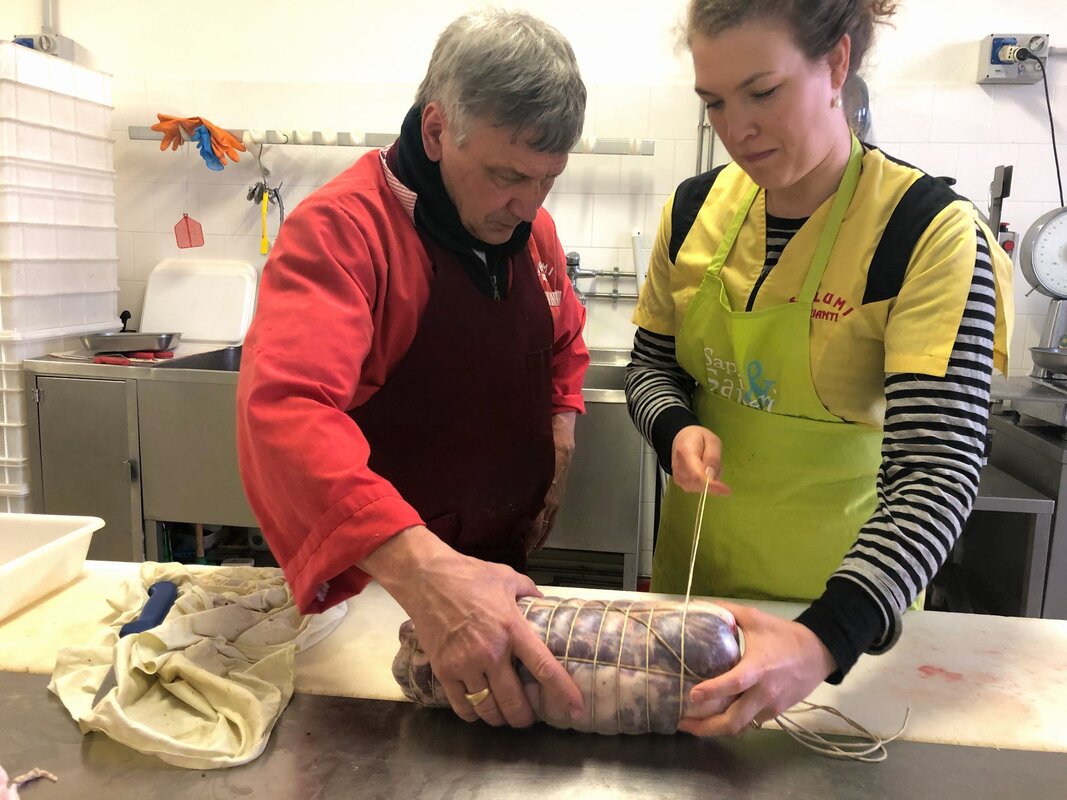 Tying coppa from Aldo Brianti's Nero di Parma pigs February saw us on the Advanced Salumi Course Bologna-Parma. We left Tuscany for Emilia (the northwestern part of Emilia-Romagna). This region of Italy is particularly famous for not one, but two delicious types of salumi— Prosciutto di Parma and Mortadella di Bologna! Check out the blog post here for more pictures and information about what happened during this tour in February! March 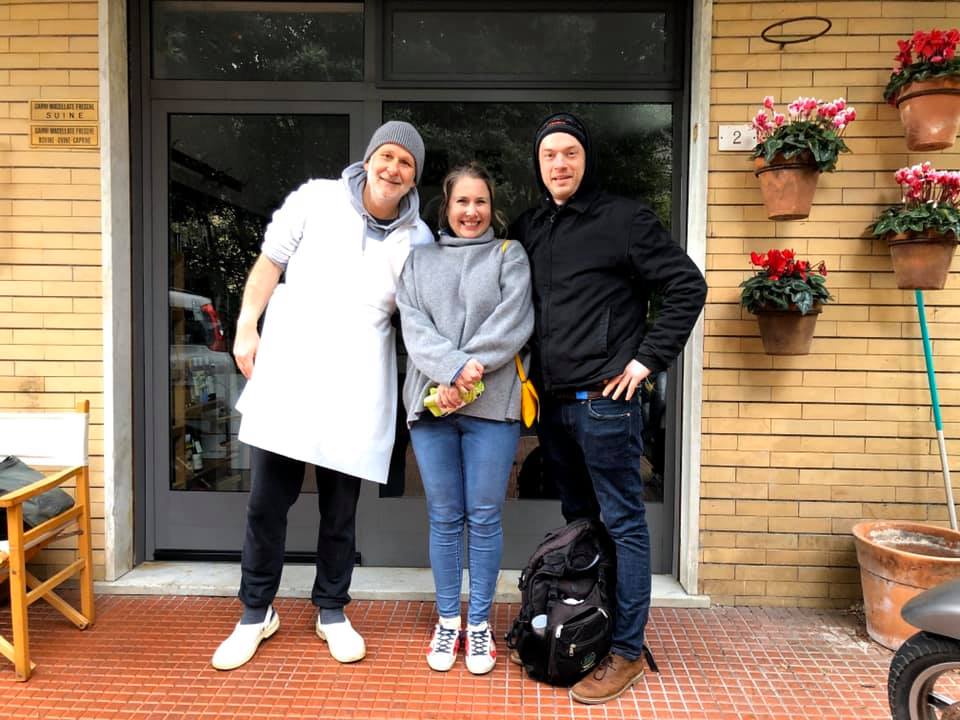 Katie and Seamus with Massimo Bacci March of course brought with it COVID-19, and in Italy things became serious very quickly! It was still an unknown entity in March, and we weren't sure how things would play out. We welcomed a couple of intrepid souls onto the Advanced Salumi Course Tuscany in March, in what would be the last course for a while! We were still hoping that things would all blow over but were concerned about the impact the travel bans would have on those looking to come on courses and tours in the near future. Anyway, Australian vodka producer Katie Krauss and American head chef Seamus Platt joined us. They managed to learn everything the course had to offer before dashing off on the last flights home! 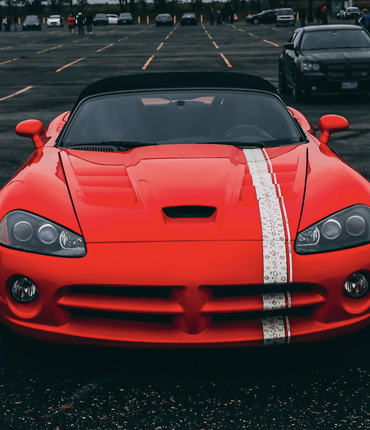 The case of the quarantined car! Erica quickly had to get used to life under lockdown, long before many other countries started to introduce such measures. It did, however, result in her having a bit of an adventure! As flights started to get cancelled across Europe, one unexpected result was the car of some friends trapped in the Pisa airport car park, which was due to close. After calling in various favours the car was freed...read exactly how in the blog post here or click the car image above! 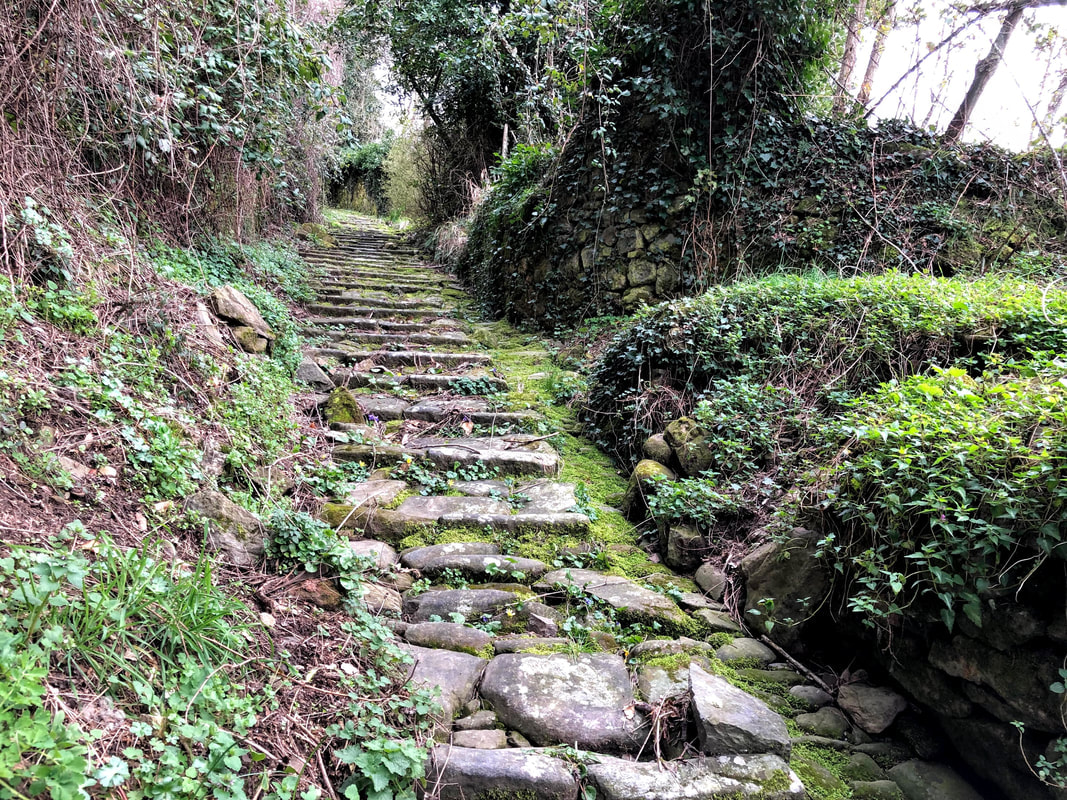 Along the mulattiera It also allowed for a bit of cooking and exploring the beautiful surroundings outside her door. More information and pictures are here in the March round up blog post. 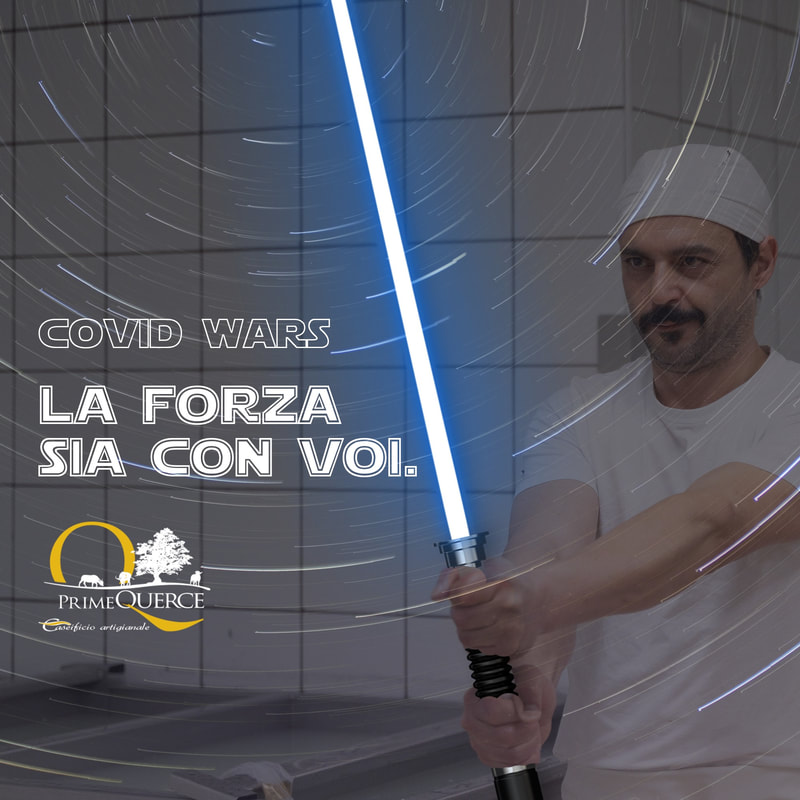 Across Italy people started to pull together in the face of tough lockdowns, travel bans and an unknown virus. Many sang and played music from balconies and out of windows. Antonio Daniele, head cheesemaker at Caseificio Prime Querce, and one of the artisans who teaches our Mozzarella & its Cousins course made this graphic and said: 'We must withstand and fight. We'll come out of this stronger than before.' April 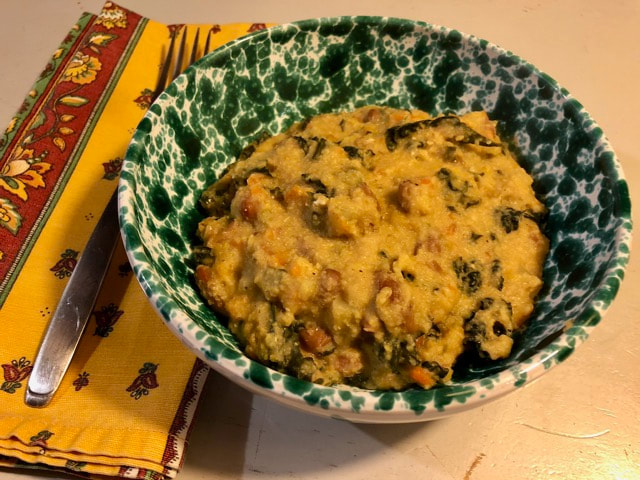 The finished infarinata In April we started to adjust to the new normal. For Erica, even cooking dinner turned into an epic adventure! This meal took her on a journey to remember people she'd met along the way and about the history of the ingredients. It really is a fantastic story, you can read the whole thing here - or by clicking the image above. 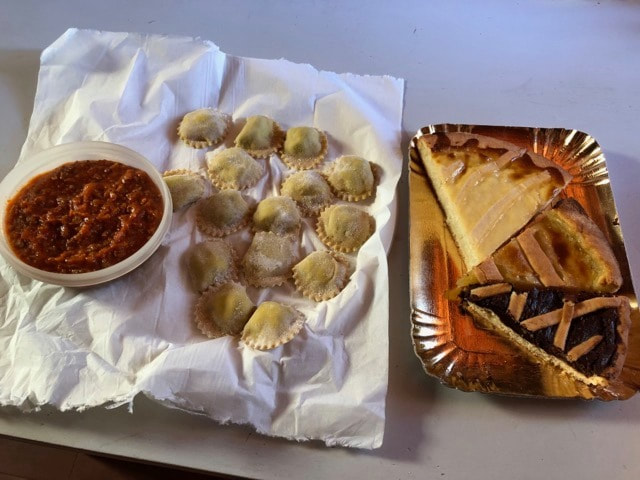 A feast delivered by the neighbours Lockdown meant Easter alone for Erica, but her neighbours certainly wouldn't see her starve! She wrote in a Facebook post: "Under lockdown they couldn't invite me to eat with them. At 11.30 am the doorbell rang. It was Eugenia with three slices of pie with different fillings—rice, lemon and chocolate. At 12.30 the doorbell rang again. It was Daniela bringing her homemade tortelli and sugo. I was only planning marinated and grilled goat chops with cannellini beans and insalata with local red wine. Now I had a three-course lunch. Such kindness and generosity, and I certainly didn't feel alone." 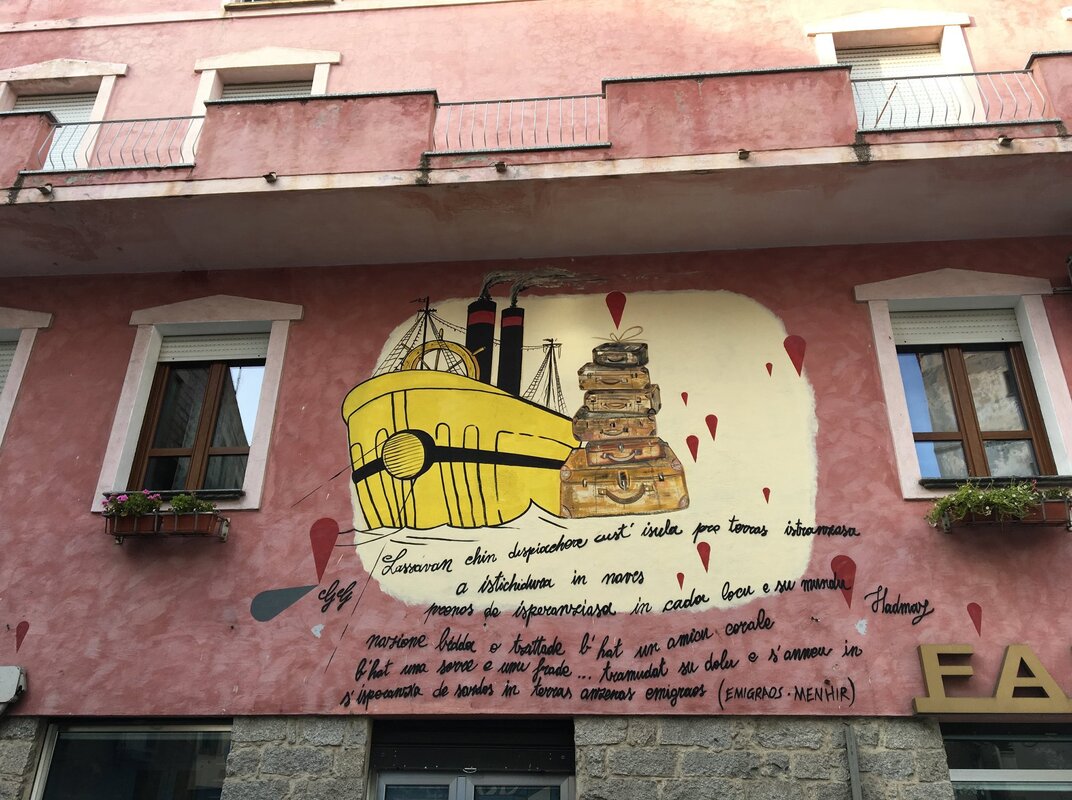 The houses in the town of Orgosolo are decorated with protest murals In April we also ran one of our first 'virtual tours' to give you all a taste of what you would have been experiencing, had you been allowed to visit Italy. We all travelled around Sardinia on the Celebrating Sardinia tour and had a great time! You can read the whole thing for yourself in the blog post here, or by clicking the image above. May 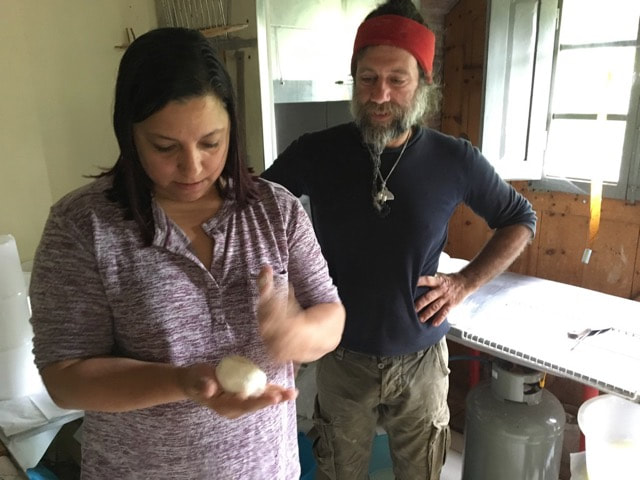 Enea casting a watchful eye... In May we would have been running the Theory & Practice of Italian Cheese course, but that was not to be of course. So we also offered a little preview on Facebook. We visited Enea Giunti's goat farm and learned how to make fresh goat cheese. We stayed at Agriturismo La Torre at Fornoli and met Vitalina who shared her extensive knowledge of cheese making. We milked cows at Marzia Ridolfi's and drove up to Daniela Pagliai's to see her small modern dairy and how she makes a number of different cheeses from one pot of milk. And all this in the company of Maria Sarnataro, a real expert on cheese! Read all about what else we saw in the blog post here. 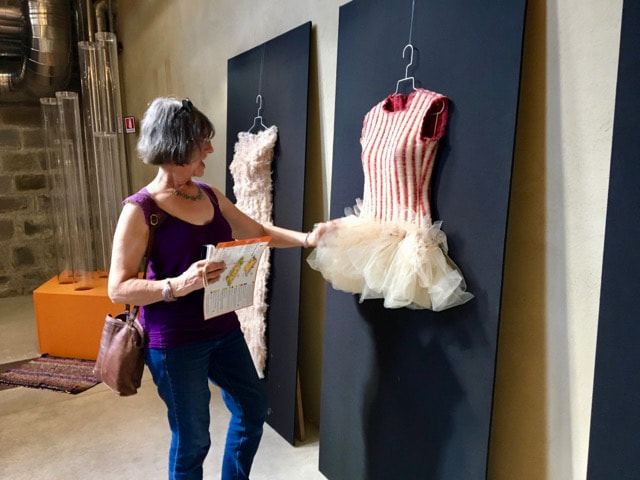 The Tastes & Textiles: Woad and Wool tour was also meant to run in May, but instead we ran it as a virtual tour. It was a fascinating tour with so many interesting sights and photos, which you can see here in the blog post. June 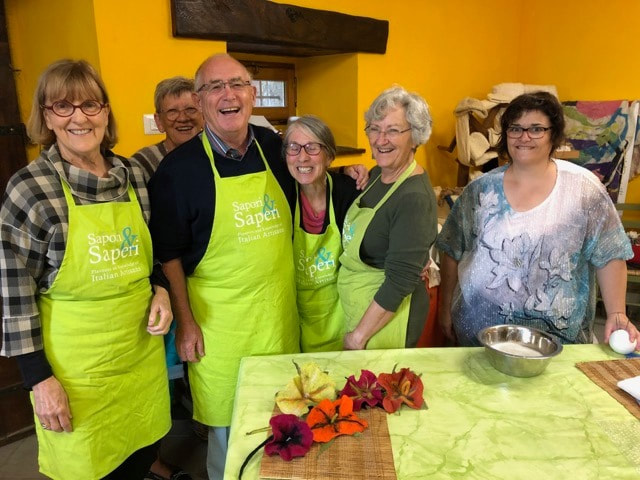 All smiles on tour Another month and another virtual tour, this time it was the Tastes & Textiles: Hanging by a Thread tour. Card weaving, farm accommodation, vineyards, Garfagnana potato bread, knitting, felting, weaving, wonderful food, an ethnographic museum, a woolen mill - it was all there and more. Read all about it in the blog post here. 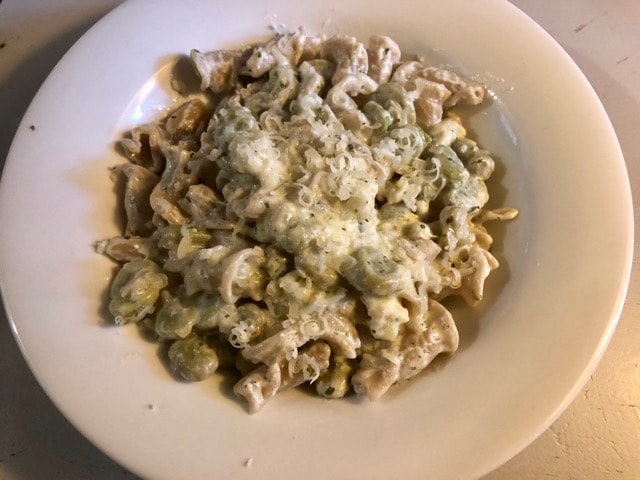 Pasta made with fava beans After the tour Erica shared some of the delicious meals she'd been making. She had been experimenting with ricotta. The people who sell it in the open-air market won't sell a small amount. She has to buy a whole one. This spring she tried this simple sauce for short pasta made with fava beans (broad beans) and ricotta - delicious! 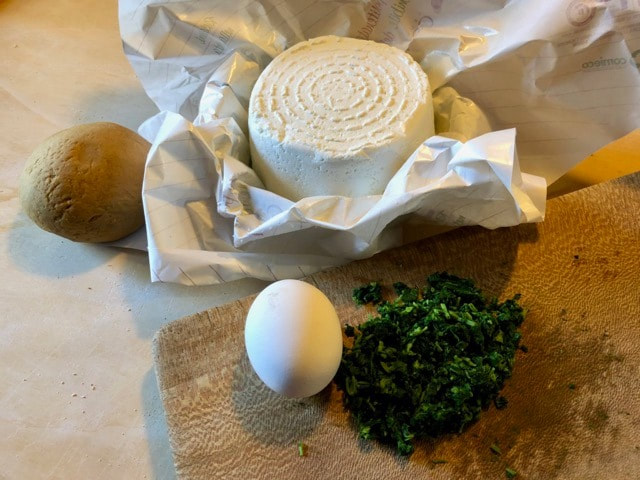 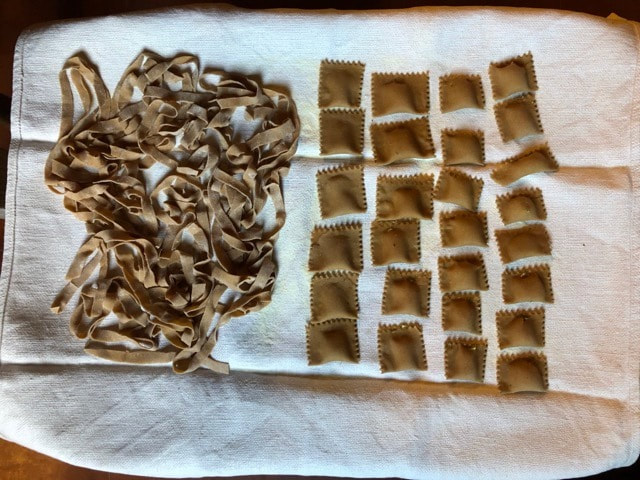 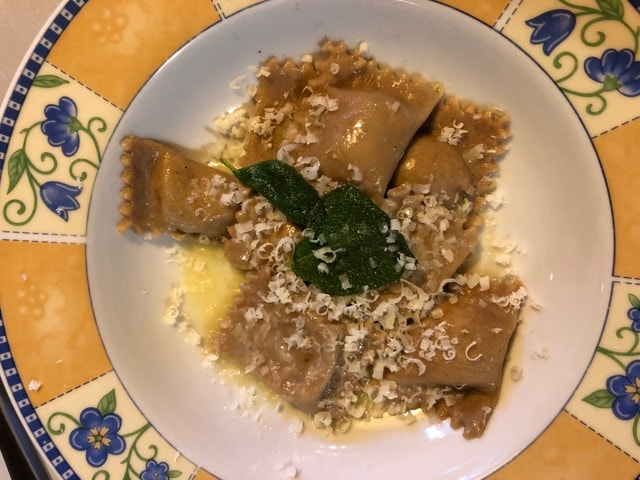 The classic dish everyone around Erica makes with ricotta is ravioli. She said of this meal: 'I have a lot of chestnut flour in my freezer—gifts from friends who collect, dry and mill their own. I made pasta di castagna (about 1/3 chestnut flour) with a filling of fresh ricotta, young nettle tops, an egg, salt, pepper, nutmeg. The slightly bitter nettles contrast well with the sweet chestnut flour. The sauce is simple melted butter with fresh sage leaves.' 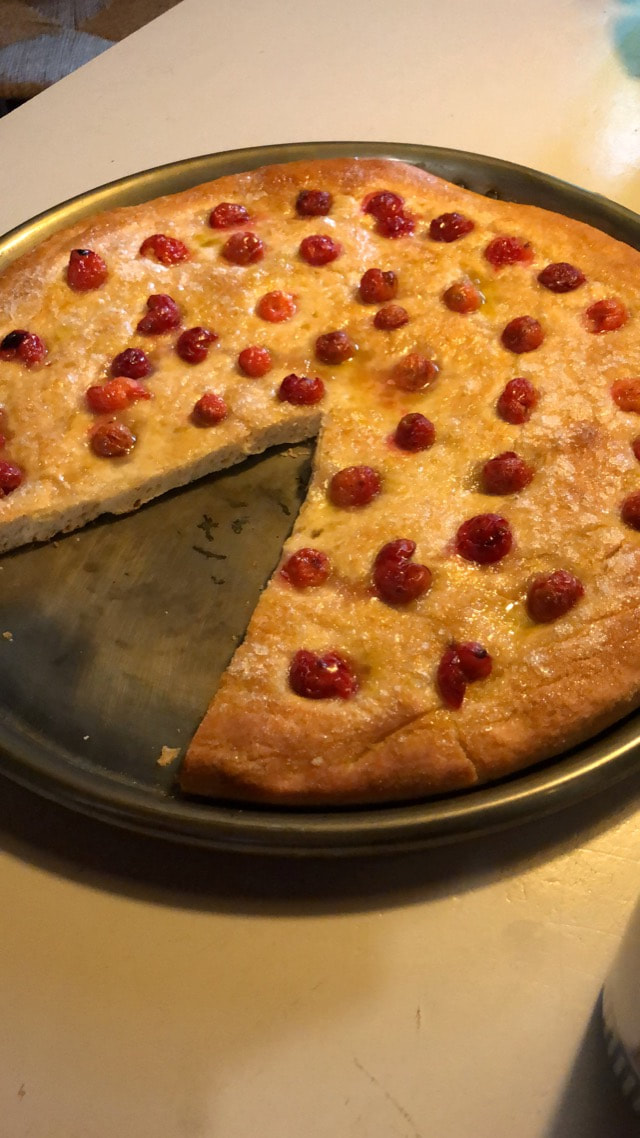 Cherry focaccia This recipe in particular got my mouth watering! There is a self-seeded cherry tree hanging over Erica's orto (veg garden). In June it produces a small crop of mildly sour cherries. Every year she makes one focaccia with the cherries, but it never turns out exactly the way she wants it. Until this year. It's exactly the thickness and degree of sweetness she'd been searching for. Persistence pays off! July and August 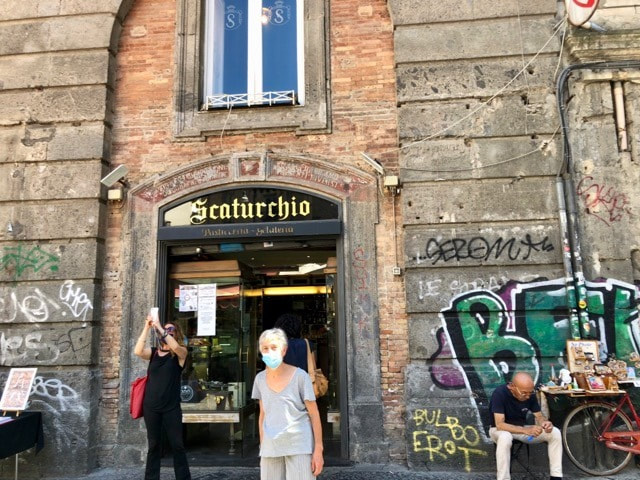 Erica outside one of Napoli's most famous pastry shops With some restrictions lessening in Italy, Erica took the chance to do some travelling! At the end of July she headed off to Pompei. She first saw the sights of Napoli and was welcomed by her collaborator on the cheese courses, Maria Sarnataro. First they tried some tasty delicacies, including the famous sfogliata. 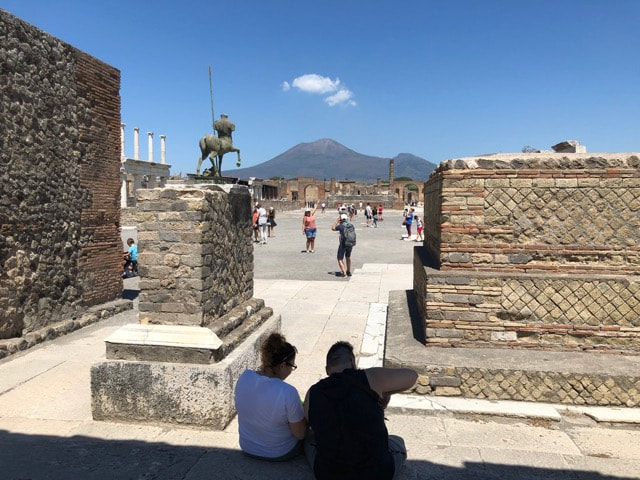 While in Pompei Erica hired a wonderful private guide, Francesco Tufano, an archaeologist who could answer all of her questions and more! Read all about the trip here in the blog post. 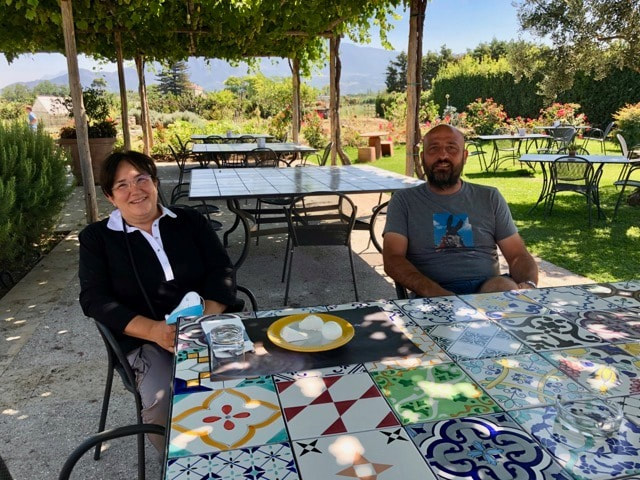 Maria with Enzo Barlotti The second half of Erica's trip took her from Pompei to Salerno where she and Maria visited some mozzarella dairies. She was very impressed when she visited Caseificio Barlotti and met brothers Enzo (pictured) and Gaetano Barlotti. She hopes to bring future participants on the Mozzarella & its Cousins course for a tasting in their beautiful garden. She had some samples of his bocconcini, ricotta and a new brie-style cheese, all made with the milk of their own buffalo herd. The mozzarella and ricotta are among the best she'd tasted. Read all about this part of the trip in the blog post here. 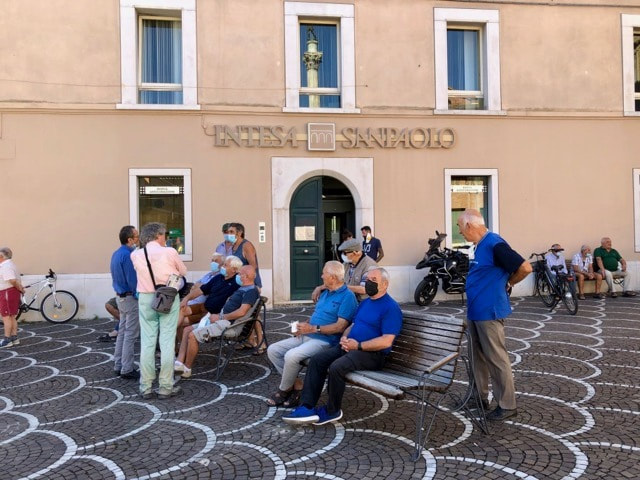 Erica also took a research trip to Le Marche for the Tastes & Textiles: Woad & Wool tour. It's during these types of trips she meets the artisan's we visit on tours and finds the incredible restaurants we dine in! Perhaps you don't know where Le Marche is. Le Marche means 'The Marches', which in English refers to an area of land on the border between two countries or territories (eg, the Welsh Marches). In fact, Le Marche borders three other regions, Emilia Romagna, Tuscany and Umbria, with the Adriatic Sea to the northeast. Before the unification of Italy in 1861, they had a lot of borders and ports to protect, which means lots of spectacular fortresses and castles to visit! This photo above was one of my favourites from the trip, showing masked men waiting for their wives to finish shopping in Urbania. During the trip she also met some fascinating people, including Federica Crocetta, who has a passion for dyeing textiles with natural plant dyes, and Emanuele Francione, who learned the craft of textile block printing with rust from his grandfather. Read all about the tour in the blog post here. September 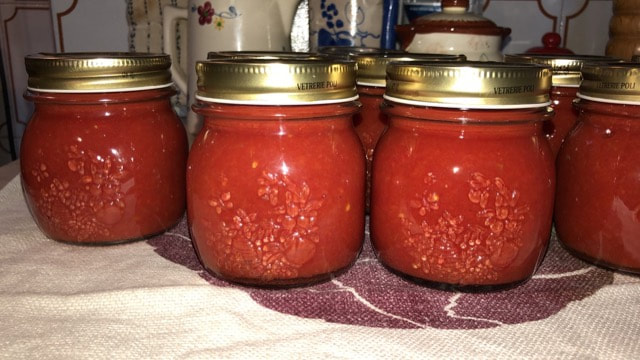 In September Erica was back home, and making passata! You can read all about it in the blog post here, or by clicking the photo above. 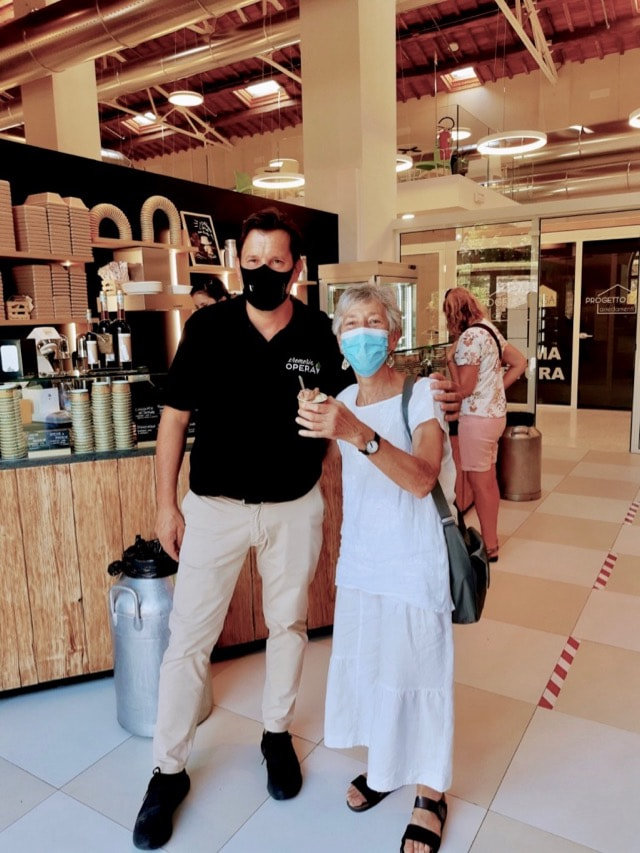 Erica and Mirko in the new Cremeria Opera There was also some excitement for Mirko, who teaches the Art & Science of Gelato course as he opened a new Cremeria Opera just outside the walls of Lucca. Erica and Mirko had a little celebration...wearing masks of course! October 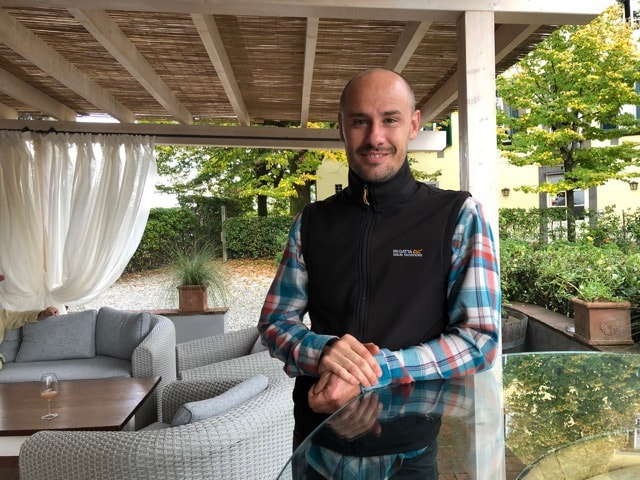 Damiano Donati In October Erica attended a fantastic lunch cooked by her favourite Lucca chef Damiano Donati. She said: 'His restaurant in the centre closed during lockdown. I was forlorn. Now he's popped up at Fattoria Sardi vineyard better than ever. He calls his fixed menu for Sunday lunch Fuoco e Materia (Fire and Matter). He was always fascinated by contrasting textures. Now he has a wood-fired oven in his kitchen and is playing with smokey flavours too, and it works. Here he is relaxing on the terrace after lunch. The dishes included: squash cooked two different ways and wrapped in chestnut leaf parcels, beetroot risotto, chicken stuffed with pork accompanied by smokey crushed potatoes. If you opt for the wine tasting, you get a different delicious biodynamic wine paired with each course.' 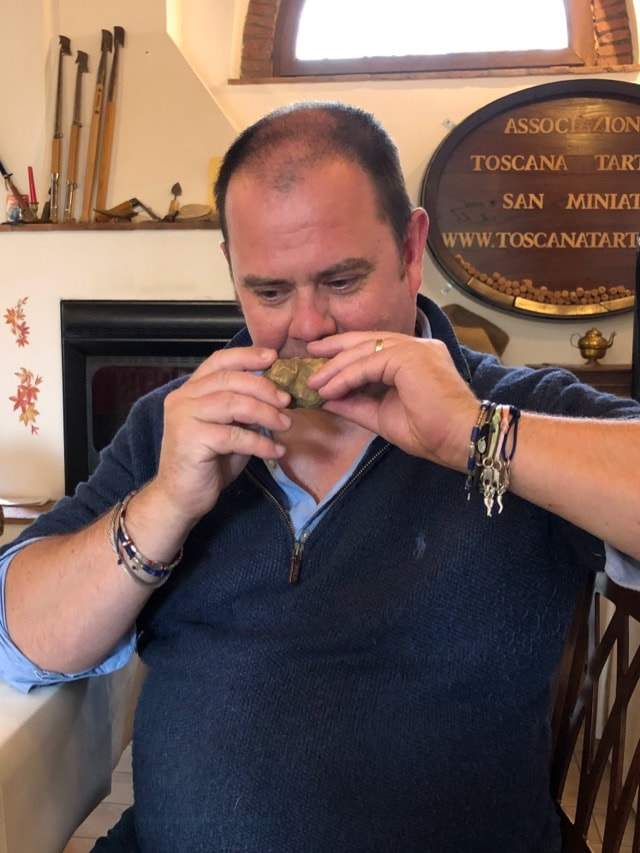 Brendan assesses a truffle There was also a little time to squeeze in some truffle hunting for a private tour! Truffle hunter Riccardo instructed Brendan in how to use three of his senses—sight, smell and touch—to assess whether the truffle is poor, mediocre or excellent. This 66 gram truffle is excellent, and after his truffle lunch with his wife and child, he decided to buy it so they could go on indulging in truffles for the rest of their holiday. 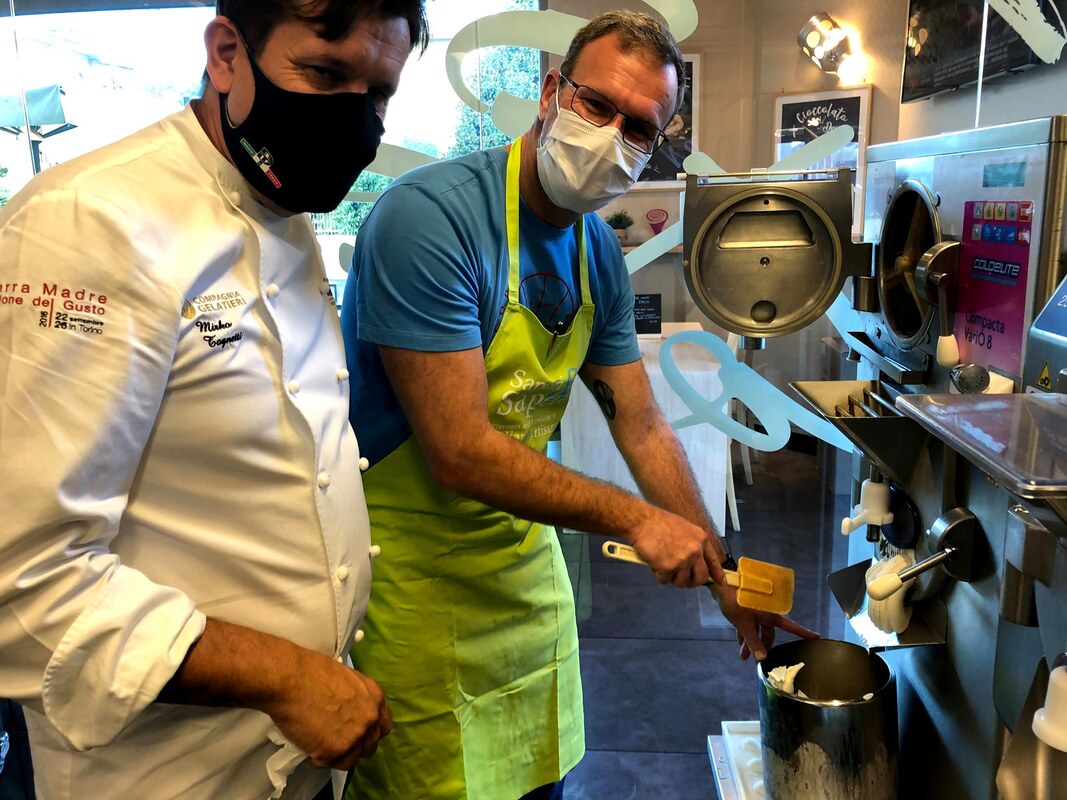 We were also delighted to be able to hold a REAL LIFE Art & Science of Gelato course in October! We welcomed Niels, chef on a super-yacht. On the October course we teach how to make sourdough panettone as well as gelato so you know how to do it in time for Christmas. For his unique flavours Neils created pineapple and rosemary sorbetto, date and whisky gelato and Piña Colada sorbetto! November 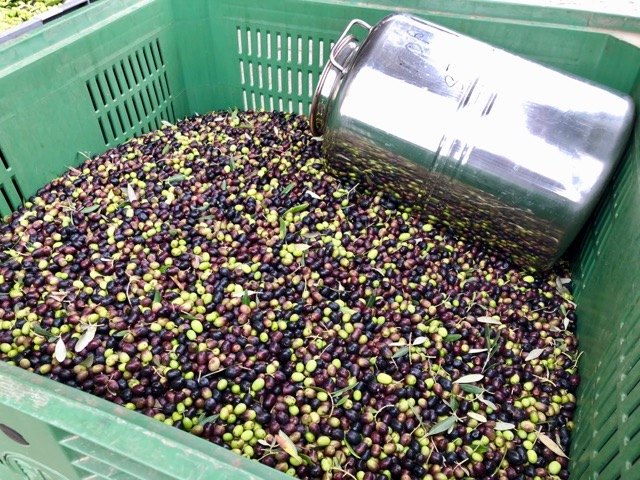 Olives ready for processing 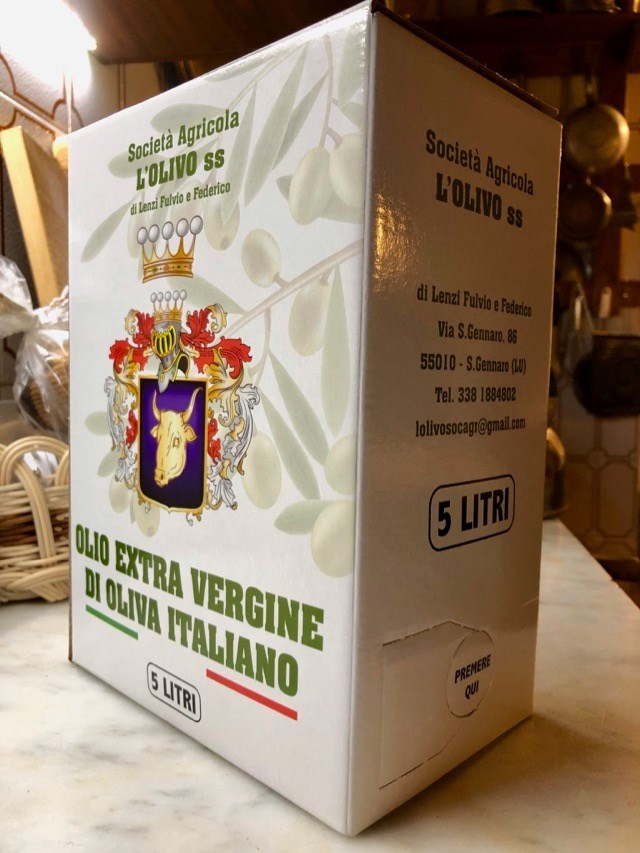 The finished product! In November Erica went to Frantoio Lenzi to get her year's supply of olive oil. At the height of the harvest, frantoi (olive mills) are open 24/7 and it's always chaotic. She picked up bag-in-box new oil. You can recycle the box, but not the bag. However, by excluding air it keeps the oil from oxidising so rapidly and preserves the health benefits and the flavour for longer. The oil is fruity (tastes like olives!), medium picante and medium bitter. Her conclusion: a nice rounded flavour. 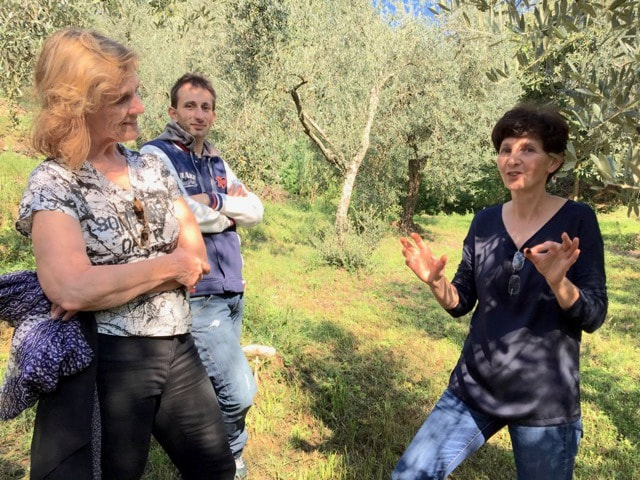 Elisabetta Sebastio (right) 2020 would have brought us the first participants on our new Olive Oil: Tree to Table in Tuscany course, but it was not to be. Nevertheless, we ran a virtual tour to whet your appetite! Read all about it in the blog post here. December 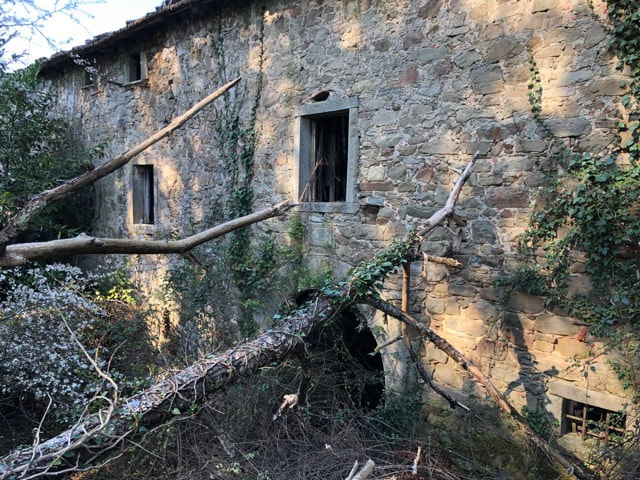 One of the most popular blog posts of the year was about the abandoned farm houses of Casabasciana. Wonderful photos and stories, can be seen in the blog post here. The year wound down with a poignant blog post featuring a video about the death of peasant farming. It was made by farmers in Umbria, but it could have been made anywhere in Italy—or in many other countries in fact. We visit many small farmers during tours and one of the things that was important when setting up Sapori e Saperi Adventures was to help preserve this way of life. You can watch it in our blog post here. 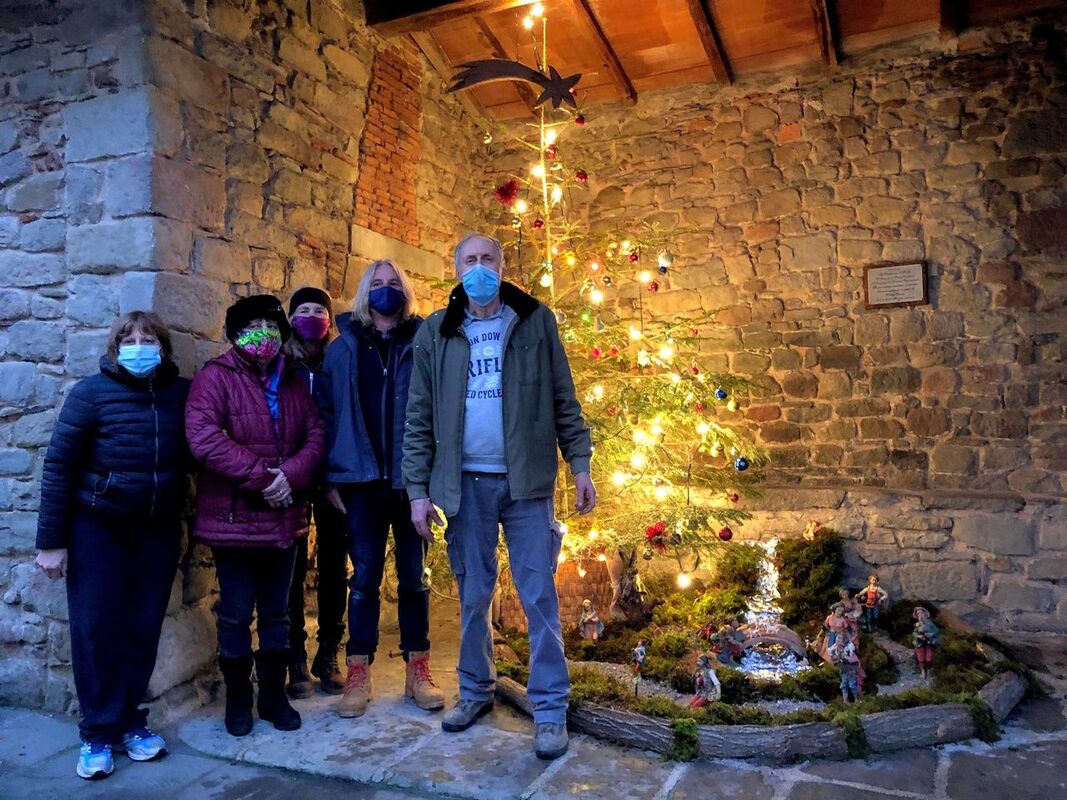 After such a trying year it was nice for Erica to join her local community to decorate the village Christmas tree, a long-standing tradition which was just a little different this year.
We hope you have had a healthy 2020 and wish you all the best for 2021. We'd love nothing more than to welcome you onto one or more of our tours and courses. Get in touch with Erica at info@sapori-e-saperi.com for more information or for answers to any questions you may have. If you landed here by chance and would like to be notified of future posts, you can sign up here. If you’d like periodic news about our tours and courses, sign up here. 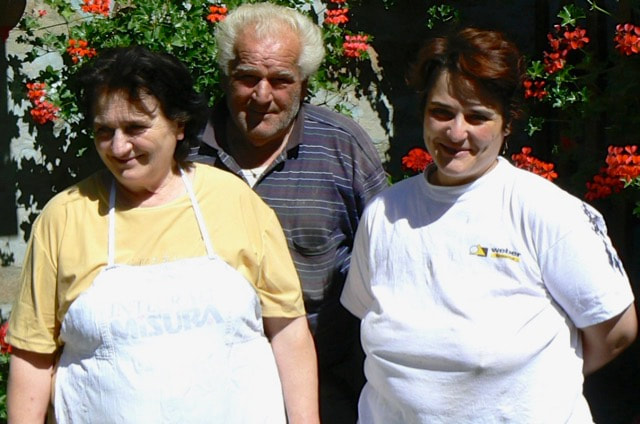 Gemma, Mario and Ombretta: sheep farmers and cheesemakers (2008) Sapori & Saperi Adventures is making tourism work to sustain the rural economy and its people. In 2005 when I was thinking about starting Sapori & Saperi Adventures, I made a list of what I wanted to achieve. I had already met small-scale family farmers cultivating the land, rearing animals and producing traditional products much as their parents and grandparents had. I had also noticed the connection people felt with the countryside and caring for it. Even city dwellers had roots in the land. Either they or their close relatives still owned farmland. They went out from the cities to pick grapes and olives. I observed that although farmers worked hard, they seemed content with their labours, proud of their produce, and had time for leisure, more leisure than I had. Often extended families stayed together, the old teaching and caring for the young and being cared for in their turn. I don’t want to romanticise, at least, not too much. Many more people have left the land than stayed. They found the work too hard or not satisfying. But those who had stayed communicated a joy which I hoped to transmit to the travellers who came to me. And I wanted to help preserve their way of life. Much of what you pay in fees to me, goes to them. You too are helping preserve their way of life. And the fact that you come all the way from distant parts of the world to see them at work reinforces their self-esteem, and perhaps helps convince their children that the family farm is worth defending. But small family farms are under attack everywhere from agribusiness. The following film, the funeral of peasant farmers, was made by farmers. They are not romantics. They know the hardships and the value of their way of life. It takes place near a small village in Umbria, the province just to the south of Tuscany, but it could be anywhere. Please watch it (and have your hankies to hand). As I started writing this blog, I Googled ‘family farm’ and discovered that the Food and Agriculture Organisation (FAO) is also worried about the demise of the family farm. Last year they introduced the UN Decade of Family Farming. Here’s why: ‘The UN Decade of Family Farming 2019-2028 aims to shed new light on what it means to be a family farmer in a rapidly changing world and highlights more than ever before the important role they play in eradicating hunger and shaping our future of food. Family farming offers a unique opportunity to ensure food security, improve livelihoods, better manage natural resources, protect the environment and achieve sustainable development, particularly in rural areas. Thanks to their wisdom and care for the earth, family farmers are the agents of change we need to achieve Zero Hunger, a more balanced and resilient planet, and the Sustainable Development Goals.’ My wish for 2021 is that together we will help save a few family farms. 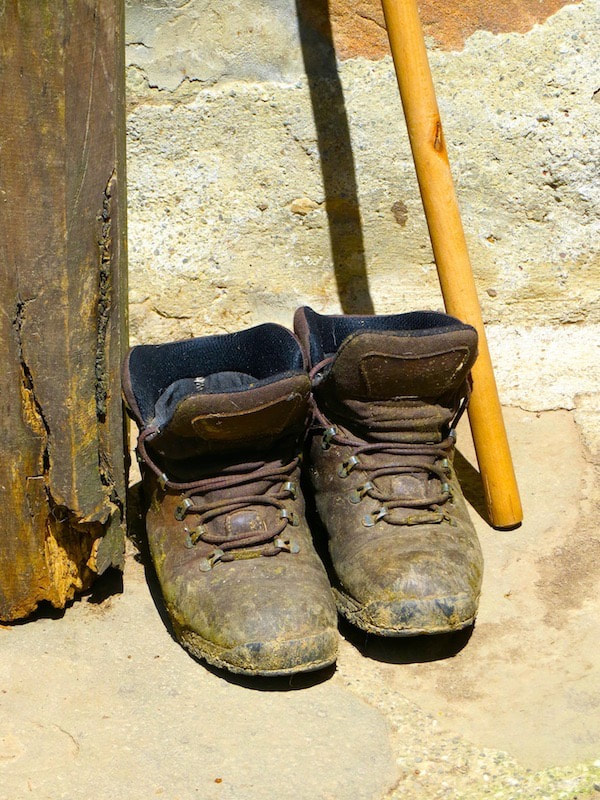 Mario's boots (Photo: Barbara Wachter) |
Email Subscription
Click to subscribe to this blog and receive notifications of new posts by email. AuthorErica Jarman Categories
All
Archives
October 2023
|
 RSS Feed

We acccept
|

Read about us
|

|

|
|
copyright 2017 sapori-e-saperi.com | all rights reserved
|
Website by Reata Strickland Design